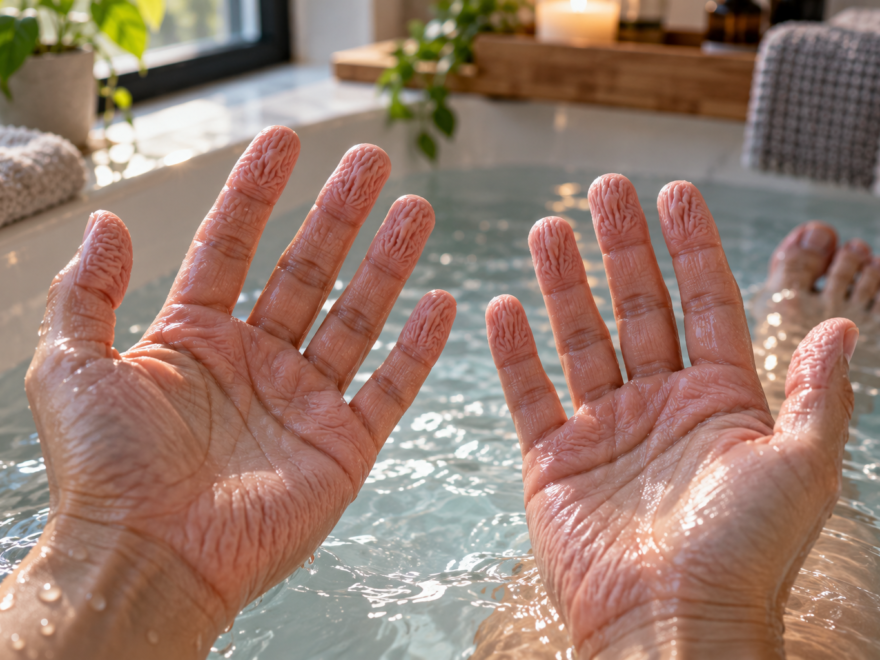
Take a long shower, spend some time in a swimming pool, or sit in a bathtub and something strange begins happening to your hands.
The skin on your fingertips starts forming deep little ridges. Stay in the water longer and your toes may do the same thing. Once you dry off, everything gradually returns to normal.
For years, the popular explanation sounded simple: your skin absorbs water, swells, and becomes wrinkled.
There is just one problem.
That explanation does not tell the whole story.
The answer to why do fingers wrinkle in water involves your nervous system, tiny blood vessels beneath the skin, and possibly an adaptation that helped humans handle wet environments more effectively.
Your Skin Is Not Simply Swelling Like a Sponge
The outermost layer of skin can absorb some water, so the old explanation was not completely unreasonable.
But if simple water absorption were responsible for wrinkling, we might expect skin all over the body to behave similarly.
It does not.
The strongest wrinkling occurs on the fingers and toes.
More importantly, research and clinical observations have shown that the wrinkling response depends on functioning nerves. When certain nerves supplying a finger are damaged, that finger may show reduced or absent water-induced wrinkling.
That suggests something much more interesting is happening beneath the surface.
Your Nervous System Is Involved
The wrinkling process is associated with the autonomic nervous system.
This is the part of the nervous system responsible for many processes you do not consciously control, such as aspects of heart rate, sweating, digestion, and blood vessel regulation.
When fingers remain in water, the nervous system can trigger blood vessels beneath the skin to constrict.
As those vessels narrow, the volume of tissue beneath the skin decreases slightly.
The surface skin then folds inward, creating the familiar wrinkles.
In other words, your fingers are not merely becoming waterlogged.
Your body is actively producing much of the effect.
That Explains Why the Wrinkles Have a Pattern
Look closely at wrinkled fingertips.
They do not usually resemble random swollen skin.
Instead, valleys and ridges form across the surface.
This structured appearance makes more sense when we understand that changes are occurring in the tissue underneath the skin.
As blood vessels constrict, the skin is effectively pulled over a slightly smaller volume beneath it.
The resulting difference creates the wrinkled surface.
Once you leave the water and normal conditions return, the blood vessels and tissues gradually return toward their usual state.
The wrinkles disappear.
Why Does It Take Several Minutes?
Your fingertips do not wrinkle the instant they touch water.
Wash your hands quickly and almost nothing happens.
Stay submerged for longer and the effect becomes obvious.
That delay makes sense because water-induced wrinkling is a physiological response rather than an instantaneous physical reaction.
Your body needs time to respond to prolonged exposure.
Temperature, individual physiology, and other factors can influence how quickly the wrinkles become noticeable.
So there is no universal stopwatch moment when every person’s fingers suddenly wrinkle.
Why Fingers and Toes?
This is where the story becomes even more interesting.
If the only purpose were to respond to wet skin, why would the effect be especially prominent on the fingers and toes?
Those happen to be the areas that interact heavily with surfaces.
Your fingers grip objects.
Your feet maintain contact with the ground.
That observation led researchers to investigate whether wrinkling might actually provide a functional advantage under wet conditions.
One intriguing idea is that the wrinkles may help with grip.
Think About the Tread on a Tire
A completely smooth tire can struggle when water sits between the rubber and the road.
Tread provides channels through which water can move.
Researchers have proposed a somewhat similar idea for wrinkled fingers.
The grooves may help water move away from contact points while the fingers hold wet objects.
This could potentially improve the interaction between the skin and slippery surfaces.
The comparison is not perfect—human skin is obviously not a car tire—but it provides an intuitive way to understand the hypothesis.
Experiments Have Tested Wet-Object Handling
Researchers have tested whether wrinkled fingers affect people’s ability to manipulate objects.
Some experiments have found that participants with wrinkled fingertips handled submerged or wet objects more efficiently than participants whose fingers were not wrinkled.
Interestingly, the same advantage was not necessarily observed when handling dry objects.
That distinction matters.
If wrinkling provides an advantage primarily in wet environments, it supports the possibility that the response has a specialized function rather than being a meaningless side effect of water exposure.
However, research on the exact performance advantages and evolutionary significance continues, so the grip explanation should be treated as a plausible hypothesis rather than an absolutely settled story.
Better Grip Could Have Been Useful to Our Ancestors
Imagine humans gathering food near streams, moving across wet rocks, handling vegetation after rainfall, or collecting objects from shallow water.
A small improvement in wet grip could potentially be useful.
Wrinkled toes might also have influenced traction when walking on wet surfaces.
From an evolutionary perspective, even modest advantages can matter if they consistently help survival or reproduction across many generations.
This is why scientists have considered water-induced wrinkling as a possible adaptation.
But there is an important distinction.
Demonstrating that wrinkles can improve performance under certain conditions is not identical to proving exactly why natural selection produced the trait.
Evolutionary explanations require careful evidence.
So Why Aren’t Our Fingers Wrinkled All the Time?
If wrinkles can improve wet grip, why not keep them permanently?
Because biological features often involve trade-offs.
The skin on our fingertips performs many tasks besides gripping wet objects. We manipulate small items, sense texture, use tools, type, and perform precise movements in dry environments.
Permanent deep wrinkling might not offer an advantage in all of those situations.
A temporary response makes more sense if its benefit is mainly associated with prolonged wet conditions.
When the environment changes, the fingers return to their normal state.
Fingerprints and Water Wrinkles Are Different Things
It is easy to confuse these two features because both create patterns on fingertips.
Fingerprints are the permanent friction ridges present on the skin.
Water wrinkles are temporary folds that become much more pronounced after prolonged immersion.
Your fingerprints do not disappear when your fingers wrinkle.
Instead, the temporary wrinkling changes the larger surface geometry around those existing ridges.
The two features therefore have different structures and origins.
Your Fingertips Are Already Specialized
Human fingertips are remarkably sophisticated pieces of biological equipment.
They contain dense sensory receptors that help detect pressure, vibration, texture, and other mechanical information.
Their friction ridges contribute to interactions with objects.
They are also highly mobile and controlled with remarkable precision.
Water-induced wrinkling is another reminder that something as ordinary as the tip of a finger contains multiple interacting biological systems.
A fingertip is not just a piece of skin covering the end of a bone.
It is part of an advanced sensory and mechanical interface between your body and the world.
Hot Water Can Make Wrinkling Seem Faster
People often notice wrinkling quickly in a warm bath or shower.
Water temperature can influence physiological responses in the skin and blood vessels, so the timing and appearance of wrinkles may vary under different conditions.
But temperature is not the fundamental explanation for why the phenomenon occurs.
You can develop wrinkled fingers in cooler water too.
The key condition is prolonged exposure to water and the body’s response to that exposure.
Salt Water Can Behave Differently
Another interesting question is whether fingers wrinkle identically in fresh water and salt water.
The concentration of dissolved substances in water can affect interactions with the skin, and experiments have investigated how salinity influences wrinkling.
The response can vary depending on the surrounding solution.
That adds another layer of complexity to what initially appears to be an extremely simple phenomenon.
Your fingers are responding not merely to the abstract concept of “being wet,” but to a specific physical and physiological environment.
Soap Is Not Required
You do not need soap, chlorine, or bath products to produce wrinkled fingertips.
Ordinary water exposure is enough.
That is useful because it rules out another common assumption: that wrinkling is caused mainly by chemicals in pools or soaps in bathwater.
Those substances may affect the skin in other ways, particularly with repeated exposure, but they are not necessary for the classic temporary wrinkling response.
A bowl of plain water can demonstrate the phenomenon.
Wrinkling Is Usually Temporary
One reassuring characteristic of ordinary water-induced wrinkling is that it goes away.
Dry your hands and wait.
As the physiological response reverses, the fingers gradually regain their usual appearance.
The exact timing varies, but you do not normally need to do anything special.
Moisturizer may help if the skin feels dry after washing or bathing, but it is not required to “unwrinkle” healthy fingers.
Your body handles that process itself.
Wrinkling and Dry Skin Are Not the Same
After a long shower, fingers can feel both wrinkled and slightly dry.
That makes the two phenomena easy to combine mentally.
But they are not identical.
Temporary immersion wrinkles involve changes associated with the nervous system and blood vessels beneath the skin.
Dry skin involves the condition of the skin barrier and its moisture balance.
Frequent washing, harsh cleansers, dry air, and other environmental factors can contribute to dryness even when your fingers are not visibly wrinkled.
Understanding the difference helps explain why moisturizer can improve dry-feeling skin without being responsible for reversing the neurological wrinkling response.
Doctors Have Even Studied the Wrinkling Response
Because the response depends on nerve function, water-induced skin wrinkling has historically attracted medical interest.
Researchers and clinicians have investigated whether the response can provide information about autonomic nerve function.
That does not mean you should start soaking your hands in a bowl of water and diagnosing yourself.
Human biology varies, and clinical interpretation requires proper context.
But it illustrates how an everyday phenomenon can reveal something meaningful about the nervous system.
The wrinkles are not merely cosmetic.
They are evidence of physiology in action.
Why Do Children Wrinkle Too?
Water wrinkles are not a sign of aging.
Children can develop them just as adults do.
The resemblance to aged skin is purely visual.
Age-related wrinkles develop through very different processes involving long-term changes in skin structure, collagen, elasticity, sun exposure, and other factors.
Water-induced wrinkles appear within minutes and disappear again.
So when a child holds up wrinkled hands after swimming and jokes about suddenly becoming old, biology is performing a completely different trick.
Can You Prevent Your Fingers From Wrinkling?
You generally do not need to.
For most healthy people, wrinkling after prolonged water exposure is a normal temporary response.
If you want to reduce it for practical reasons, limiting prolonged immersion or using appropriate waterproof gloves for wet work may help reduce direct exposure.
But there is usually no health reason to fight the wrinkles themselves.
They are simply part of how the body responds to the environment.
What If Only One Finger Does Not Wrinkle?
This is where the nervous-system connection becomes especially fascinating.
Because intact nerve signaling contributes to the response, differences in nerve function can alter wrinkling.
Historically, observations of fingers with nerve injuries helped scientists recognize that simple water absorption could not fully explain the phenomenon.
That discovery transformed a mundane bath-time curiosity into evidence about human physiology.
However, differences between fingers should not be self-diagnosed from a home soaking experiment.
If someone has persistent numbness, weakness, pain, unusual color changes, or other neurological symptoms, those symptoms deserve appropriate medical evaluation rather than internet experimentation.
The Simplest Explanation Was Almost Right—but Not Enough
“Skin absorbs water and wrinkles.”
It is a satisfying explanation because it is easy to visualize.
And the outer skin does interact with water.
But science often advances when someone notices that a simple explanation cannot account for every observation.
Why mainly the fingers and toes?
Why does nerve damage alter the response?
Why do blood vessels constrict?
Why does the pattern potentially improve handling of wet objects?
Each question reveals another layer.
The final explanation becomes more interesting than the original one.
Your Body Is Constantly Making Adjustments You Never Notice
You do not consciously tell the blood vessels in your fingertips what to do.
You do not calculate how much heat should leave your skin.
You do not manually regulate every sweat gland or digestive movement.
Much of human physiology operates automatically.
Water-induced finger wrinkling provides a rare case where one of those hidden adjustments becomes extremely visible.
You can literally watch your nervous system change the shape of your skin.
That is remarkable for something most of us have seen hundreds of times.
Conclusion
So, why do fingers wrinkle in water?
It is not simply because your skin absorbs water like a sponge. Prolonged water exposure triggers a response involving the autonomic nervous system, which causes blood vessels beneath the skin to constrict. The resulting reduction in tissue volume helps create the characteristic folds across the fingers and toes.
Researchers have also found evidence that these wrinkles may improve the handling of wet objects, leading to the hypothesis that they could have provided a useful grip advantage in wet environments. The precise evolutionary story remains an area where scientists continue to investigate the evidence.
What makes the phenomenon so interesting is how ordinary it feels.
You take a bath.
Your fingers wrinkle.
They dry.
The wrinkles disappear.
Yet hidden inside that familiar experience are nerves, blood vessels, biomechanics, and potentially millions of years of evolutionary history.
Sometimes the strangest science is already sitting at the ends of your fingers.