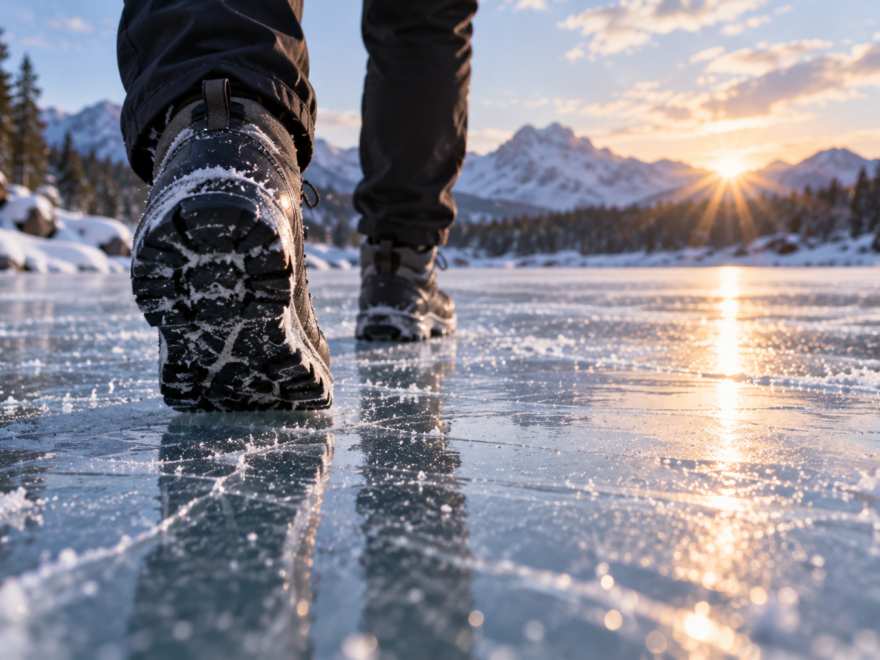
Step onto a dry sidewalk and your shoes usually grip the surface without much thought. Step onto a patch of ice, and suddenly a tiny shift in weight can send your feet sliding forward.
The obvious explanation seems simple: ice is smooth.
But smoothness alone cannot fully explain it. Plenty of polished surfaces are smooth without being nearly as slippery as ice, while even rough-looking ice can still provide surprisingly little grip.
The answer involves the unusual behavior of water molecules at the surface of ice, friction, temperature, and the thin layer that can develop between the ice and whatever moves across it.
Ice Is a Solid, but Its Surface Is Unusual
Inside a piece of ice, water molecules are arranged in an organized crystal structure.
Molecules at the surface are different.
They do not have neighboring molecules surrounding them in exactly the same way as molecules deeper inside the crystal. Because of this incomplete bonding environment, the outermost region can be more mobile than the rigid structure beneath it.
Scientists often describe this as a quasi-liquid layer.
It does not mean an ice cube is permanently covered by a normal puddle of water. Instead, the molecular behavior at the surface can resemble a very thin, disordered layer compared with the solid ice underneath.
That unusual surface is an important part of understanding ice friction.
The Old Pressure Explanation Is Only Part of the Story
A familiar explanation says ice becomes slippery because your body weight increases pressure beneath your shoes, melting the ice.
This idea has some historical importance, but it does not provide a complete explanation for everyday slipping.
Pressure can affect the melting point of ice, but the pressure produced by ordinary shoes is generally not enough to explain all the slipperiness we experience.
Ice can also be slippery under conditions where pressure melting alone would not account for what happens.
Modern explanations therefore consider several mechanisms rather than relying on pressure by itself.
Friction Can Generate Heat
When two surfaces move against each other, friction can convert some mechanical energy into heat.
The same principle applies when a skate, ski, tire, or shoe moves across ice.
That local heating can contribute to changes at the contact surface. Under suitable conditions, it may help produce or maintain a very thin layer of water that reduces resistance.
This does not mean every slip instantly creates a visible film of melted ice.
The interaction happens on a very small scale at the interface between the surfaces.
A Tiny Amount of Water Can Dramatically Change Grip
Think about trying to slide two dry objects against each other.
Their microscopic bumps and irregularities interact, creating resistance.
Introduce a suitable fluid between them and the situation can change.
On ice, a very thin mobile layer can reduce direct interaction between your shoe and the solid surface beneath it. Instead of gripping the rigid ice effectively, the contact can become easier to slide across.
Only a small amount is required.
You do not need to see a puddle for the surface conditions to change.
Temperature Changes How Slippery Ice Feels
Not all ice behaves exactly the same way.
Temperature matters.
Ice close to its melting point can have more surface mobility and may develop more liquid water, particularly when exposed to sunlight, friction, or warmer surroundings.
This can make relatively warm ice extremely slippery.
At much colder temperatures, the surface behaves differently and can provide greater friction under some conditions.
That is one reason walking on ice during severe cold can sometimes feel different from walking on ice when temperatures hover close to freezing.
This Is Why “Cold Ice” and “Wet Ice” Can Feel Different
Imagine two frozen surfaces.
One has been sitting in extremely cold conditions. The other is close to melting and has a slight wet sheen.
Both are ice, but your shoes may interact with them differently.
The near-melting surface can contain more liquid water, creating conditions that favor sliding.
Temperature therefore changes more than whether the ice remains frozen.
It can change the characteristics of the contact surface itself.
Smooth Ice Still Makes the Problem Worse
If smoothness is not the whole explanation, does surface texture matter?
Absolutely.
A smooth surface gives your footwear fewer irregularities to catch against. Add the unusual low-friction properties of ice, and maintaining grip becomes even more difficult.
Rough ice may offer somewhat more mechanical interaction.
But roughness alone does not eliminate the underlying surface behavior.
That is why ice does not need to look perfectly polished to be hazardous.
Why Do Ice Skates Glide So Easily?
Ice skating takes advantage of the same general low-friction environment.
A skate blade concentrates force over a narrow contact area while moving rapidly across the surface.
The interaction between blade, ice, friction, and the mobile surface layer allows the blade to glide with relatively low resistance.
But skating is not simply uncontrolled slipping.
The shape and edges of the blade allow a skater to interact with the ice differently depending on angle.
A skilled skater can glide in one moment and use an edge to turn or stop in the next.
Skating Is Not Just “Melting a Path”
You may have heard that a skate works by melting ice directly underneath the blade and riding on the resulting water.
That explanation is appealing because it is easy to visualize.
Reality is more nuanced.
Surface mobility exists even before the blade arrives, while frictional heating and pressure can influence conditions during skating. Exactly how these factors contribute depends on temperature, speed, load, and other variables.
The important point is that no single “the blade melts everything” explanation captures the full physics.
Tires Face the Same Basic Grip Problem
Cars also depend on friction.
On dry pavement, tire rubber can interact effectively with the textured road surface.
Ice changes that interaction dramatically.
When the contact surface provides much less friction, braking, acceleration, and steering become more difficult because all three depend on the tires transferring force to the ground.
A driver can turn the steering wheel, but the vehicle can only change direction effectively if the tires have enough grip to produce the necessary force.
Low friction limits that ability.
Why Sudden Movements Become a Problem
When grip is limited, aggressive inputs demand more friction than the surface may be able to provide.
A sudden step can make a foot slide.
Hard acceleration can make a tire lose traction.
Sharp steering can exceed available grip.
This is why controlled movement matters on slippery surfaces.
The physics is not that ice somehow pushes an object sideways. Instead, there may not be enough friction to produce the change in motion you are asking for.
The object then continues moving more than expected.
Why Does Sand Help?
Sand does not need to melt the ice to be useful.
Its main advantage is texture.
The particles create a rougher interface between footwear or tires and the icy surface. This can increase mechanical grip and make slipping less likely.
That is why sand or grit can be useful even when conditions are too cold for melting to happen quickly.
It changes the contact surface.
Salt Works Differently
Salt addresses the problem through chemistry rather than simply adding roughness.
Dissolved salt lowers the freezing point of water. Under suitable temperature conditions, this can encourage ice to melt and make it harder for liquid water to refreeze at the normal freezing point of pure water.
However, salt is not equally effective at every temperature.
As conditions become sufficiently cold, common deicing approaches become less effective.
That is why road maintenance strategies can vary depending on weather conditions.
Why Can Refrozen Ice Be Especially Difficult to See?
Some of the most dangerous ice does not look like the dramatic white surface we imagine.
A thin layer can form on pavement and remain relatively transparent, allowing the darker road underneath to remain visible.
This is commonly associated with what people call black ice.
The name does not mean the ice itself is black.
The underlying pavement shows through the transparent ice, making the frozen layer difficult to distinguish from an ordinary wet road.
The friction can change dramatically even when the appearance changes very little.
Why Walking Like Normal Can Fail
Normal walking includes moments when one foot pushes backward against the ground to move the body forward.
On a high-friction surface, this happens automatically.
On ice, that backward push may exceed the available friction.
The foot slides backward instead of providing the expected support.
Taking smaller, more controlled steps can reduce the horizontal forces demanded from the surface.
You are effectively asking less from the limited grip available.
Your Shoes Matter Too
Footwear changes the interaction between your body and the ice.
A sole designed with useful tread can provide more opportunities for mechanical grip than a hard, smooth sole.
But tread does not magically eliminate the low-friction properties of ice.
Material, tread geometry, temperature, surface conditions, and how you move all influence traction.
That is why footwear that feels secure on wet pavement may still perform poorly on smooth ice.
Why Doesn’t Ice Feel Equally Slippery Everywhere?
Real-world ice is messy.
One patch may be rough and frosty.
Another may have been polished by repeated traffic.
One area may sit in direct sunlight while another remains shaded. Snow, salt, dirt, water, temperature changes, and repeated melting and freezing can all alter the surface.
So when people ask why is ice slippery, there is no requirement that every frozen surface produce exactly the same amount of friction.
The underlying physics is influenced by local conditions.
Ice Is a Good Example of Everyday Physics Being Complicated
“Frozen water is slippery” is something most people learn through experience long before they study the science behind it.
That familiarity makes the phenomenon seem simple.
But once you ask what is actually happening between a shoe and the ice, the answer reaches into molecular structure, phase behavior, friction, lubrication, pressure, and heat transfer.
This happens constantly in science.
Ordinary observations can hide surprisingly complex mechanisms.
The interesting question is often not whether something happens.
It is why.
Conclusion
So, why is ice slippery?
It is not simply because ice is smooth, and the traditional explanation that pressure from your feet melts the surface does not tell the entire story.
The surface of ice has unusual molecular properties that can create a thin, mobile layer. Temperature, frictional heating, pressure, surface texture, and the presence of liquid water can then influence how easily objects slide across it.
Near the melting point, conditions can become especially slippery because more liquid water may be present at the interface.
That tiny boundary between solid ice and whatever touches it is enough to change how effectively forces can be transferred.
The next time your shoe unexpectedly slides across a frozen sidewalk, the interesting part is not merely that ice has little grip.
It is that an incredibly thin region at the surface can determine whether you stay standing or suddenly discover physics the hard way.