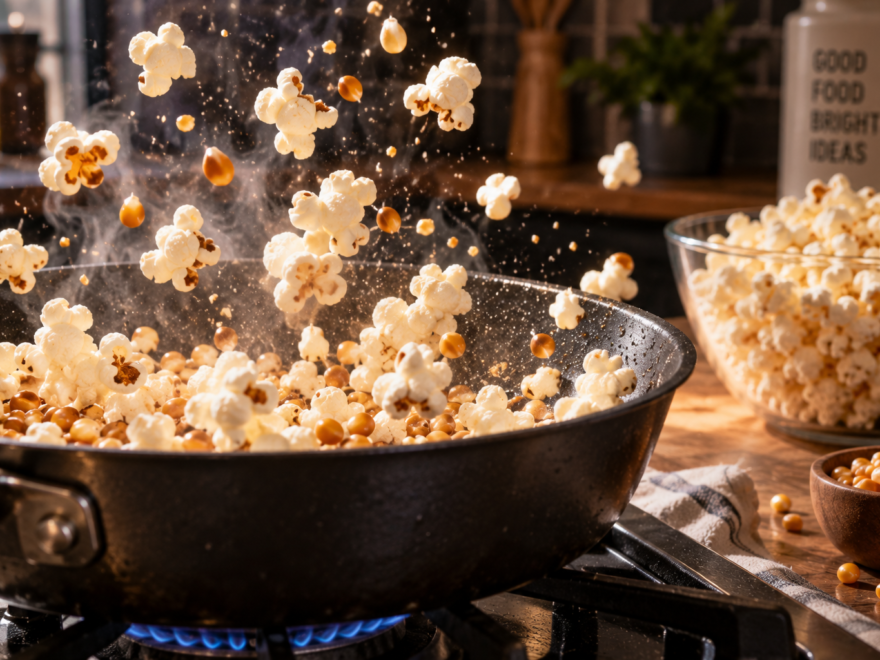
Drop a handful of popcorn kernels into a hot pan and, for the first few moments, almost nothing happens.
The kernels sit there looking exactly as they did in the bag. Then one suddenly bursts. Another follows. Within seconds, the pan fills with rapid pops and small yellow kernels transform into irregular white pieces several times their original size.
It looks simple enough to be ordinary.
But why popcorn pops is actually a neat combination of water, pressure, temperature, starch, and a remarkably strong outer shell. A popcorn kernel is essentially a tiny pressure vessel designed by biology—and heating it pushes that structure toward a dramatic breaking point.
A Popcorn Kernel Is Not Completely Dry
Popcorn may look dry, but there is still moisture inside each kernel.
That small amount of water is essential.
The kernel also contains starch and other material surrounded by a tough outer layer called the pericarp, or hull.
When the kernel is heated, the water inside begins gaining thermal energy. Eventually, some of that water turns into vapor.
The important part is what happens next.
The vapor cannot easily escape.
The Hull Traps Pressure Inside
If steam could simply leave the kernel as it formed, popcorn would be far less exciting.
Instead, the hull acts as a strong barrier.
As temperature rises and more water becomes vapor, pressure builds inside the kernel. Meanwhile, the starch inside becomes increasingly hot and soft.
For a while, the hull is strong enough to contain the pressure.
This is why the kernel can sit quietly in the pan even though major changes are already happening inside it.
Nothing visible has happened yet.
Internally, however, the kernel is approaching its limit.
Eventually the Hull Can No Longer Hold
Pressure does not increase forever.
At some point, the outer shell fails.
The hull ruptures rapidly and the pressurized interior suddenly encounters the much lower pressure outside the kernel.
This rapid pressure drop allows water vapor to expand.
The softened starch expands along with it.
What had been tightly packed inside a tiny kernel is suddenly pushed outward, producing the familiar white structure we recognize as popcorn.
The “pop” is therefore not just the corn cracking open.
It is the result of a rapid pressure release and expansion.
The White Part Was Already Inside
Popcorn can look as though something new has appeared during cooking.
The small golden kernel becomes a much larger white object.
But the material was already there.
Most of what we see after popping comes from the kernel’s starchy interior.
Heating changes its physical structure.
As the hull ruptures, the hot starch expands rapidly and then cools into the airy shape we eat.
So popcorn is not gaining a huge amount of new material.
It is dramatically increasing in volume.
Why Doesn’t Ordinary Corn Do the Same Thing?
This raises an obvious question.
If popcorn is corn, why can’t we throw any dried corn kernel into a pan and expect the same result?
Because not all corn varieties have the same physical properties.
Popcorn is a particular type of maize with characteristics that make popping possible, including a hard outer hull capable of containing pressure and an internal composition suitable for expansion.
Other corn varieties may crack, dry, burn, or behave differently when heated.
They do not necessarily create the same combination of pressure containment and starch expansion.
That makes the popcorn kernel unusually well suited to this miniature explosion.
Moisture Has to Be in the Right Range
Water is necessary for the process, but the balance matters.
A kernel with too little internal moisture may not generate enough steam pressure to pop effectively.
That can leave hard, unpopped kernels at the bottom of the pan.
Excess moisture can also affect how well popcorn performs.
This is one reason proper storage matters.
Popcorn is not simply a completely dry ingredient waiting for heat. Its ability to pop depends partly on retaining the internal moisture needed to create pressure.
Why Are There Always a Few Unpopped Kernels?
At the bottom of almost every bowl of popcorn are a few stubborn kernels.
They experienced the same pan.
The same oil.
The same heat.
Yet they refused to pop.
There can be several reasons.
A kernel may have insufficient moisture. Its hull may be damaged, allowing vapor to escape before enough pressure develops. Heat may also have been distributed unevenly.
If the kernel cannot create and maintain the necessary internal pressure, the dramatic expansion never occurs.
Instead, it remains mostly intact.
A Tiny Crack Can Ruin the Process
The strength of the hull is one of the most important parts of why popcorn pops.
Imagine trying to inflate a balloon with a hole in it.
Air escapes before meaningful pressure develops.
A damaged popcorn kernel can face a similar problem.
If its hull allows water vapor to leak out too early, internal pressure may never reach the point needed for proper popping.
This is why kernels that look almost identical can behave very differently once heated.
The important difference may be a tiny structural defect that is difficult to see.
Why Does Popcorn Turn Inside Out?
Watch a slow-motion video of a kernel popping and the transformation looks almost violent.
The hull breaks, the interior expands, and the kernel rapidly changes orientation.
This is partly because the expanding starch does not simply inflate neatly like a balloon.
The rupture occurs at a point in the shell, and the expanding material pushes outward through that opening.
The mechanical forces involved can cause the kernel to flip, jump, and unfold.
What ends up in the bowl is effectively the expanded interior of a structure that has rapidly ruptured and reorganized itself.
Why Does Popcorn Jump?
The same rapid expansion that transforms the kernel can also launch it.
When the hull ruptures, the kernel undergoes a sudden mechanical change.
Parts of its structure move quickly as the starch expands, and the force against the cooking surface can send the kernel into the air.
That is why popcorn does not simply become white while remaining perfectly still.
The transformation itself can produce movement.
A pan full of popcorn is therefore filled with many tiny mechanical events happening in rapid succession.
Why Doesn’t Every Kernel Pop at the Same Time?
Even if kernels come from the same package, they are not perfectly identical.
They may differ slightly in size, moisture content, hull condition, and how efficiently they receive heat.
Their positions in the pan also matter.
One kernel may be in better contact with a hot surface while another receives heat slightly more slowly.
Each kernel therefore reaches its critical conditions at a different moment.
The familiar sequence—one pop, a pause, then a rapid storm of popping—is the result of many individual kernels crossing their thresholds at slightly different times.
Why Does Shaking the Pan Help?
When making popcorn on a stovetop, recipes often recommend moving or shaking the pan.
One reason is heat distribution.
A kernel sitting continuously against one very hot spot can overheat, while another kernel may receive insufficient heat.
Movement helps expose kernels more evenly to the hot cooking environment.
It can also help move already-popped pieces away from prolonged contact with the hottest surface.
The goal is not to shake the kernels into popping.
It is to manage how heat reaches them.
Oil Is Useful, but Oil Is Not What Makes Popcorn Pop
Because stovetop popcorn is commonly cooked in oil, it is easy to assume oil creates the popping reaction.
The crucial ingredient inside the kernel is actually water.
Oil mainly helps transfer heat efficiently from the cooking surface to the kernels and contributes to flavor and texture depending on the preparation method.
Popcorn can also be produced using hot air.
That alone demonstrates that immersion in oil is not required for the basic popping mechanism.
Heat plus the kernel’s internal structure are the key ingredients.
Microwave Popcorn Uses the Same Basic Physics
A microwave bag looks completely different from a saucepan, but the kernel itself still follows the same fundamental process.
Microwave energy heats components of the food, including water within the kernels.
As the kernels become hot, internal pressure develops.
Eventually, suitable kernels rupture and expand.
The packaging and added ingredients affect the cooking environment and final flavor, but the basic transformation inside each kernel remains recognizable.
The kitchen appliance changes.
The underlying physics does not.
Why Does the Popping Suddenly Slow Down?
At first, there may be only a few isolated pops.
Then the rate increases rapidly.
Eventually, it slows again.
This pattern reflects how many kernels are reaching popping conditions at a given moment.
Once most of the kernels capable of popping have already burst, fewer remain.
Continuing to apply intense heat indefinitely will not necessarily persuade every remaining kernel to pop.
Instead, the popcorn already produced may begin to burn.
That is why listening to the changing interval between pops can be useful during cooking.
Why Is Burned Popcorn So Easy to Make?
Popping happens quickly once the pan reaches an effective temperature.
That creates a narrow practical window.
The first kernels need enough heat to build pressure, but already-popped corn has a much larger exposed structure that can remain in contact with the hot environment.
If heating continues too long after popping slows, those pieces can overheat.
The smell of burned popcorn can therefore appear surprisingly quickly.
The process changes from “waiting for something to happen” to “everything is happening at once” within a short period.
Popcorn Has Two Familiar Shapes
Not every popped kernel has exactly the same structure.
Popcorn is often described using two broad shape tendencies: butterfly and mushroom forms.
Butterfly popcorn develops irregular projections or “wings,” creating the familiar fluffy shape commonly associated with movie-style popcorn.
Mushroom popcorn tends to form a rounder, more compact shape.
Variety and popping conditions can influence the final form.
This is why popcorn used for coatings such as caramel may look structurally different from the pieces in another bag.
The physics is similar, but the final geometry can vary.
The Expansion Makes Popcorn Feel Like Much More Food
A small amount of kernels can produce a surprisingly large bowl.
Again, the kernels did not suddenly acquire several times more matter.
Their volume expanded dramatically.
This changes the way we perceive the food.
Before heating, the kernels are dense and compact. After popping, much of the structure is airy and spread over a larger space.
The transformation is a simple example of how physical structure can dramatically change the appearance and texture of the same material.
The Sound Tells You Something Physical Happened
The word “popcorn” emphasizes the sound for good reason.
That sharp sound accompanies the rapid rupture and pressure release occurring in the kernel.
It is evidence of a very fast mechanical event.
We normally encounter pressure changes on much larger scales—inside tires, aerosol containers, pressure cookers, and industrial systems.
Popcorn offers a tiny, harmless everyday example that can happen hundreds of times in a kitchen within a few minutes.
The scale is small.
The underlying idea of contained pressure followed by rapid release is much broader.
Popcorn Is a Kitchen Science Experiment You Can Eat
The interesting thing about popcorn is that nothing about the process requires exotic laboratory equipment.
You have water changing behavior as it is heated.
You have a shell containing increasing pressure.
You have starch changing under heat.
You have structural failure.
Then you have rapid expansion and cooling.
All of those processes happen inside an object small enough to sit on the tip of a finger.
We experience the result so frequently that it is easy to forget how unusual the transformation actually is.
Conclusion
So, why popcorn pops comes down to a remarkably effective natural structure.
A popcorn kernel contains a small amount of water surrounded by starch and a tough hull. Heating turns some of that water into vapor, while the shell temporarily prevents it from escaping.
Pressure rises.
The starch inside becomes hot and soft.
Eventually, the hull can no longer contain the pressure and ruptures. The sudden pressure drop allows the interior to expand rapidly, producing the white, airy popcorn we recognize.
And those annoying kernels left at the bottom of the bowl?
They are a useful reminder that the process requires several conditions to work together.
A little water, enough heat, a strong shell, and the right internal structure are what turn an ordinary-looking seed into one of the kitchen’s smallest explosions.