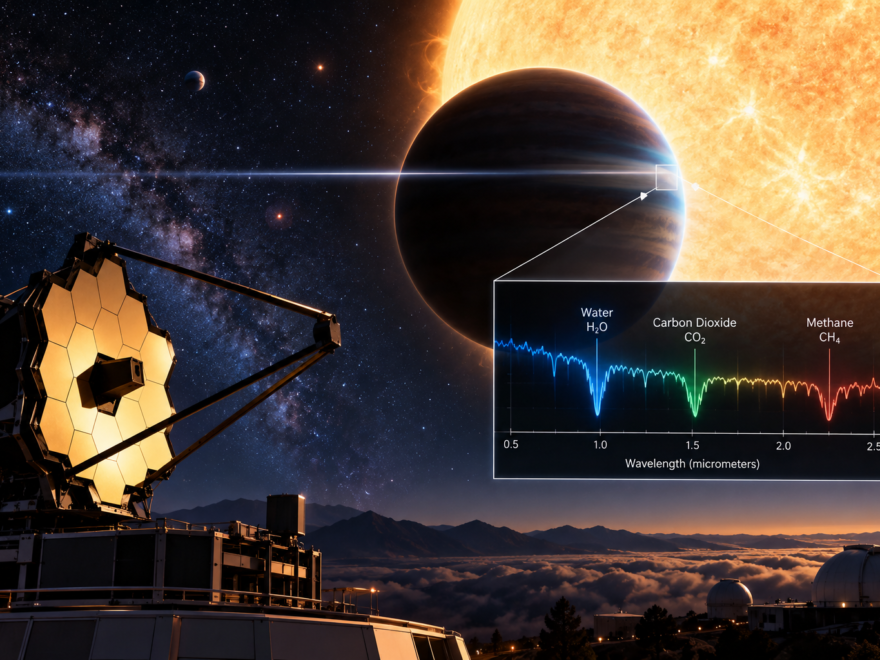
Imagine trying to figure out what is floating in the air above a world hundreds of light-years away.
You cannot send a probe there.
You cannot scoop up a sample.
In many cases, you cannot even see the planet as a recognizable disk. It may appear only indirectly through tiny changes in the light coming from its star.
Yet astronomers can still investigate whether that distant world has water vapor, carbon dioxide, methane, sodium, or other molecules in its atmosphere.
At first, that sounds almost impossible.
How could a telescope near Earth determine the composition of an exoplanet atmosphere when the planet itself is so unimaginably far away?
The answer begins with something surprisingly ordinary:
Light.
An Exoplanet Atmosphere Leaves Clues in Light
Light looks simple when we see it with our eyes.
A star appears white, yellow, orange, or red.
But when scientists separate that light into its component wavelengths, much more information appears.
This produces a spectrum.
You can think of a spectrum as a highly detailed version of a rainbow.
Different atoms and molecules interact with specific wavelengths of light in characteristic ways. Some wavelengths pass through. Others are absorbed or emitted more strongly.
Those patterns can act like fingerprints.
By studying them, astronomers can investigate what kinds of material the light encountered before reaching a telescope.
That basic idea is called spectroscopy.
And spectroscopy is one of the most powerful tools we have for studying worlds we cannot physically visit.
A Spectrum Is More Than a Rainbow
Imagine shining white light through a prism.
The light separates into different colors.
Red.
Orange.
Yellow.
Green.
Blue.
And wavelengths our eyes cannot see.
Scientific instruments can measure these wavelengths with far greater precision than human vision.
Instead of simply seeing colors, researchers can look for subtle changes in brightness across the spectrum.
Certain molecules absorb particular ranges of wavelengths.
If those patterns appear in observations, scientists can compare them with known physical and chemical signatures.
That allows light to carry information about matter across enormous distances.
The Star Provides the Flashlight
An exoplanet does not need to produce much visible light of its own for astronomers to study its atmosphere.
Its star can provide the illumination.
This becomes particularly useful when the planet passes between its star and our telescope.
That event is called a transit.
From our perspective, the planet crosses part of the star’s face.
The star becomes slightly dimmer.
That tiny reduction in brightness already tells astronomers something important.
A planet is there.
But the atmosphere can leave an additional signal.
The Planet Blocks Most of the Light
During a transit, the solid body of the planet blocks part of the star.
But around that body may be a thin layer of atmosphere.
Some starlight passes through this atmospheric region before continuing toward us.
As the light travels through the atmosphere, atoms and molecules can absorb particular wavelengths.
The telescope receives the remaining light.
Scientists can then compare what they observed when the planet was in front of the star with what they observed when it was not.
The difference can contain information about the atmosphere.
This technique is known as transmission spectroscopy.
The Atmosphere Acts Like a Filter
Picture sunlight passing through colored glass.
The glass changes the light that emerges.
A planetary atmosphere can do something conceptually similar, although the physics is far more detailed.
Different gases interact with different wavelengths.
Water vapor has spectral features.
Carbon dioxide has features.
Methane has features.
Sodium has features.
Other atoms and molecules leave their own patterns.
Scientists do not simply look at a planet and visually recognize these gases.
They measure how the light changes.
The Signal Is Incredibly Small
This is where the achievement becomes remarkable.
The planet may already block only a small fraction of its star’s light.
The atmosphere is an even thinner region surrounding the planet.
So the atmospheric signal can be extremely subtle.
Astronomers are trying to identify tiny wavelength-dependent changes within an already small transit signal.
That requires sensitive instruments, repeated observations, careful calibration, and sophisticated analysis.
The telescope is not taking a photograph of clouds and reading their chemical labels.
Researchers are extracting information from very small changes in light.
Why Bigger Atmospheres Can Be Easier to Study
Not every exoplanet atmosphere is equally easy to observe.
A large planet with an extended atmosphere can create a stronger transmission signal than a small rocky world with a compact atmosphere.
Hot atmospheres can also expand farther outward.
That is one reason many early atmospheric studies focused on large planets orbiting close to their stars.
They provide relatively favorable observing conditions.
This does not necessarily make them the most Earth-like planets.
It makes them useful laboratories for developing and testing atmospheric techniques.
Hot Jupiters Became Natural Laboratories
Some exoplanets are giant worlds orbiting extremely close to their stars.
They are commonly called hot Jupiters.
Their sizes can be comparable to Jupiter, while their temperatures may be dramatically higher because of their tight orbits.
From an observational perspective, several characteristics can make them attractive targets.
They are large.
Their transits can produce noticeable signals.
Their atmospheres may be extended.
And their short orbital periods can create frequent opportunities to observe repeated transits.
Studying these worlds helped astronomers develop techniques that could later be applied to more challenging planets.
But Scientists Want to Study Smaller Worlds Too
A giant gas planet is fascinating.
But one of the biggest long-term questions is whether astronomers can characterize atmospheres around smaller rocky planets.
These observations are much more difficult.
A smaller planet blocks less starlight.
A thinner atmosphere produces a weaker signal.
Clouds can hide features.
Stellar activity can complicate measurements.
And a potentially Earth-like world may require extremely precise observations.
The difficulty increases dramatically.
But so does the scientific importance.
Why the Host Star Matters So Much
When studying an exoplanet, astronomers are also studying its star.
That is unavoidable.
The star provides the light used for many atmospheric measurements.
But stars are not perfectly uniform lamps.
They can have spots.
Flares.
Active regions.
Changes in brightness.
Different parts of a stellar surface can have slightly different characteristics.
These effects can interfere with the planetary signal.
A feature that initially appears to come from an atmosphere may need to be separated carefully from behavior associated with the star.
The Planet and Star Are Mixed Together in the Data
This is one reason exoplanet science requires caution.
The observation does not arrive with separate labels saying:
“This signal came from the star.”
“This one came from the planet.”
“This one came from the instrument.”
Scientists must model and disentangle these contributions.
That process introduces uncertainty.
A detection can therefore have different levels of confidence.
Some measurements are robust.
Others remain tentative and require additional observations.
Scientific conclusions become stronger when independent data and methods support the same interpretation.
Clouds Can Hide What Scientists Want to See
Clouds are familiar on Earth.
They are also important in exoplanet science.
A thick cloud or haze layer can obscure deeper parts of an atmosphere.
Imagine trying to look through fog.
The objects behind it may still exist, but the fog prevents you from seeing them clearly.
Something similar can happen in a transmission spectrum.
Clouds or hazes can flatten or weaken spectral features that would otherwise reveal atmospheric composition.
A featureless spectrum therefore does not necessarily mean there is no atmosphere.
Sometimes it means the atmosphere is difficult to see through.
A Flat Spectrum Can Still Be Interesting
Science is not only about dramatic detections.
Suppose astronomers expect to see strong molecular features.
Instead, the spectrum looks relatively flat.
That result can still constrain possible explanations.
Perhaps clouds are present.
Perhaps the atmosphere has a different composition.
Perhaps it is more compact than expected.
Perhaps the original atmospheric model was wrong.
A non-detection can eliminate possibilities.
That is still information.
Telescopes Observe Wavelengths Our Eyes Cannot See
Human vision covers only a small part of the electromagnetic spectrum.
Astronomers can observe beyond visible light.
Infrared wavelengths are particularly valuable for studying many molecules in planetary atmospheres.
Different telescopes and instruments cover different wavelength ranges.
Combining observations can therefore reveal a broader picture.
One instrument might detect a feature another cannot access.
This is one reason modern astronomy relies on specialized instruments rather than simply building a telescope that “zooms in farther.”
The goal is often not magnification.
It is measurement.
The James Webb Space Telescope Changed the Level of Detail
The James Webb Space Telescope is especially powerful in infrared astronomy.
Its instruments can use spectroscopy to investigate exoplanet atmospheres with remarkable precision.
During a transit, Webb can measure the spectrum of a star while its planet passes in front.
Researchers compare those observations with the star’s spectrum outside transit.
The resulting differences can reveal atmospheric features.
Webb has already demonstrated how much chemical information can be extracted from distant planetary systems.
But interpreting that information still requires careful modeling.
Detecting a Molecule Is Not the Same as Photographing It
When headlines say scientists “found carbon dioxide” or “detected water” in an atmosphere, it can sound as if the telescope directly photographed those molecules.
That is not what happens.
Scientists observe spectral features consistent with how those molecules interact with light.
Then they compare the data against atmospheric models.
The strength and shape of the features help constrain which compositions are plausible.
So atmospheric detection is an inference built from physics, measurement, and statistical analysis.
It can be extremely strong evidence without being a literal photograph of individual molecules.
Scientists Build Models of Possible Atmospheres
Suppose a spectrum contains several features.
Researchers need to ask:
What atmospheric composition could produce this pattern?
They create models.
One model might contain more water vapor.
Another might contain more methane.
Another could include clouds.
Temperatures can be varied.
Pressure can be varied.
Chemical abundances can be varied.
Researchers then compare the predictions from these models with the actual observations.
The models that reproduce the data most successfully become stronger explanations.
One Spectrum Can Have More Than One Possible Explanation
This is an important limitation.
Real data contains uncertainty.
Spectral features can overlap.
Clouds complicate interpretation.
Different combinations of atmospheric properties may produce similar observations.
Scientists therefore do not always obtain one unique answer.
Instead, they may determine a range of atmospheric compositions that fit the data.
Additional observations can narrow that range.
This is normal science.
Uncertainty is not evidence that nothing was learned.
It tells us how precisely the current evidence supports a conclusion.
Temperature Can Also Be Measured Indirectly
Composition is not the only information hidden in planetary light.
Astronomers can also investigate temperature.
One method involves observing a planet as it moves behind its star.
This event is called a secondary eclipse.
Before the eclipse, the telescope receives light from both the star and planet.
When the planet disappears behind the star, its contribution temporarily vanishes.
By comparing the two measurements, astronomers can isolate some of the planet’s emitted or reflected light.
That can provide information about temperature and atmospheric properties.
A Planet Can Have a Day Side and Night Side
Planets orbiting extremely close to their stars may be tidally locked.
One side continuously faces the star.
The other faces away.
That creates a fascinating atmospheric question:
How effectively does the planet move heat from its day side to its night side?
Astronomers can investigate this using changes in brightness as the planet moves through its orbit.
The resulting measurement is called a phase curve.
Instead of obtaining only one atmospheric snapshot, researchers can study how the planet’s brightness changes with orbital position.
Phase Curves Can Reveal Weather on Worlds We Cannot See
Think about how extraordinary this is.
The planet may be a tiny unresolved point beside a distant star.
Yet changes in its light can provide clues about heat distribution.
That can tell scientists something about atmospheric circulation.
If the hottest region is shifted away from the point directly facing the star, winds may be redistributing heat.
Researchers can therefore investigate atmospheric dynamics without seeing individual clouds or storms directly.
It is weather science performed through light curves.
Direct Imaging Offers Another Path
Transmission spectroscopy depends on favorable orbital geometry.
The planet needs to pass in front of its star from our viewpoint.
But not every planetary system is aligned that way.
Another approach is direct imaging.
The idea sounds simple:
Take a picture of the planet.
In practice, it is extraordinarily difficult.
Stars are incredibly bright compared with the planets orbiting them.
Trying to see a faint planet beside its star can be compared to trying to spot a tiny dim object beside an overwhelmingly bright light from a huge distance.
Astronomers Need to Suppress Starlight
Special technologies can block or suppress the star’s light so that nearby planets become easier to detect.
One technique uses a coronagraph inside a telescope.
Future missions may use increasingly sophisticated approaches to separate planetary light from stellar glare.
Once enough planetary light is isolated, spectroscopy can potentially analyze that light too.
This is particularly important for the long-term goal of studying smaller planets at wider orbital distances.
Why Astronomers Care So Much About Atmospheres
Knowing a planet’s size and mass tells us a great deal.
But atmosphere adds another layer.
Two planets with similar sizes could have dramatically different environments.
One might have a thick hydrogen-rich atmosphere.
Another might be wrapped in carbon dioxide.
Another could have lost most of its atmosphere.
Another might contain clouds that conceal much of its chemistry.
Atmospheres influence temperature, climate, circulation, surface conditions, and how energy moves around a planet.
Understanding the atmosphere therefore helps transform a point on a chart into something closer to a physical world.
Atmospheres Can Tell Us About Planetary History
An atmosphere is not necessarily permanent.
It can evolve.
Radiation from the host star may strip gases away.
Volcanic activity may release gases.
Chemical reactions can change atmospheric composition.
Impacts can add or remove material.
Molecules can escape into space.
So the atmosphere observed today may contain clues about what happened to the planet over billions of years.
Atmospheric science is partly planetary archaeology.
Some Planets Are Losing Their Atmospheres Right Now
Certain exoplanets orbit extremely close to active stars.
High-energy radiation can heat their upper atmospheres.
Gas may escape into space.
Astronomers can sometimes detect signatures of this escaping material.
This provides an opportunity to observe planetary evolution in progress.
Instead of only asking what an atmosphere contains, scientists can ask:
How long can the planet keep it?
A Habitable Zone Does Not Guarantee a Habitable Planet
When a planet is discovered at a distance from its star where liquid water could potentially exist under suitable conditions, it may be described as being within the habitable zone.
But orbital distance is only part of the story.
Atmosphere matters enormously.
A planet could be at a seemingly favorable distance and still have hostile surface conditions.
Its atmosphere might be too thick.
Too thin.
Absent.
Or chemically very different from Earth’s.
That is why characterizing an exoplanet atmosphere is so important when discussing potential habitability.
Venus Is a Useful Warning
Earth and Venus are similar in size.
Yet their surface environments are radically different.
Venus has a dense carbon dioxide atmosphere and extreme surface temperatures.
This shows why knowing a planet’s approximate size and orbital location is not enough.
Atmospheric conditions can transform the environment.
When astronomers discover an Earth-sized exoplanet, the phrase “Earth-sized” therefore should not automatically be interpreted as “Earth-like.”
Size is only one property.
Mars Provides Another Contrast
Mars demonstrates a different atmospheric outcome.
It has a much thinner atmosphere than Earth.
Evidence shows that ancient Mars once had liquid water flowing across its surface, yet the planet evolved into the cold, dry world we see today.
Earth, Venus, and Mars illustrate three dramatically different atmospheric histories within our own solar system.
Exoplanets may reveal an even wider range.
The Search for Biosignatures Is Much Harder Than Finding Water
This is where discussions about exoplanets can become overexcited.
Suppose scientists detect water vapor.
That would be interesting.
But water alone does not prove life.
Water exists in many environments without biology.
The same caution applies to many individual molecules.
A potential biosignature is a substance or pattern that might indicate biological activity.
But researchers must ask whether non-biological processes could create the same signal.
There Is Probably No Single “Alien Molecule”
People sometimes imagine that astronomers will discover one chemical that immediately proves extraterrestrial life.
Reality is likely to be more complicated.
Methane can be produced biologically.
But it can also arise through geological processes.
Oxygen can be associated with life.
But under some planetary conditions, non-biological processes may also allow oxygen to accumulate.
Context matters.
Scientists therefore want combinations of gases, planetary conditions, stellar environments, and chemical relationships that are difficult to explain without biology.
Biosignatures Require Context
Imagine detecting oxygen.
Interesting.
Now ask:
What kind of star does the planet orbit?
How much water is present?
What is the planet’s temperature?
Are there other gases?
Could ultraviolet radiation produce the observed chemistry?
Could atmospheric escape explain it?
Could geological processes create similar conditions?
A biosignature cannot be interpreted in isolation.
The entire planetary system becomes part of the investigation.
False Positives Are a Major Scientific Challenge
A false positive occurs when something appears to indicate life but can actually be produced without life.
Researchers take this possibility seriously.
Before claiming a biological explanation, they need to examine plausible non-biological alternatives.
This caution can make scientific progress appear slow.
But it is essential.
Finding life beyond Earth would be one of the most significant discoveries in human history.
The evidence needs to be exceptionally strong.
The Star Can Create False Clues Too
Remember that the star is part of the measurement.
Stellar activity can alter the radiation reaching a planet.
That radiation drives atmospheric chemistry.
It can also complicate observations directly.
Understanding the host star is therefore essential for interpreting possible biosignatures.
A planet cannot be studied as though it exists independently in empty space.
Its environment matters.
One Observation Is Rarely the End of the Story
A telescope detects an interesting feature.
That does not usually mean:
Case closed.
Instead, the result creates new questions.
Can another observation reproduce it?
Does another instrument see the same feature?
Could stellar contamination explain it?
Does a different atmospheric model fit equally well?
What happens if additional wavelengths are observed?
Science becomes stronger through repetition and independent constraints.
Why Headlines Sometimes Sound More Certain Than Papers
Scientific papers often use careful language.
Possible.
Consistent with.
Suggests.
Candidate.
Evidence for.
Could indicate.
News headlines have less room.
They may compress a nuanced result into something much stronger.
“Possible atmospheric signature” can become:
“Scientists discover…”
This is why reading scientific news carefully matters, especially for claims about extraterrestrial life.
The difference between detection, interpretation, and proof can be enormous.
“We Found a Molecule” and “We Found Life” Are Very Different Statements
Suppose a telescope identifies strong evidence for methane.
The first question is:
Is methane really present?
If yes, the next question is:
How much?
Then:
How could it be produced?
Then:
How long would it survive in that atmosphere?
Then:
Could geological chemistry explain it?
Then:
Could biology explain it?
Each step requires additional evidence.
Jumping directly from molecule to life skips most of the science.
Better Telescopes Do Not Eliminate Uncertainty
Future observatories will provide better data.
But better data often creates new questions rather than simply removing uncertainty.
A low-resolution spectrum might suggest one molecule.
A higher-resolution spectrum may reveal three overlapping molecules.
More precision can expose greater complexity.
That is a feature of science, not a failure.
The closer we look, the more detailed the problem becomes.
Exoplanet Atmospheres Can Be Nothing Like Earth’s
It is tempting to use Earth as the default template.
But the exoplanet population has already revealed worlds with sizes, temperatures, densities, and orbits unlike those in our solar system.
Some planets may have clouds made from materials unfamiliar in everyday terrestrial weather.
Others experience extreme temperatures.
Some orbit their stars in only a few days.
Some may have enormous hydrogen-rich atmospheres.
The diversity is part of what makes atmospheric science so interesting.
A “Year” Can Last Only a Few Days
Many well-studied exoplanets orbit close to their stars.
Their orbital periods can therefore be astonishingly short.
A planet may complete an entire orbit in several Earth days.
That can be useful observationally.
If a transit occurs every few days, astronomers get repeated opportunities to collect data.
A planet taking a year to orbit provides far fewer transit opportunities during the same observing period.
Orbital geometry therefore affects what scientists can realistically measure.
Distance Is Not the Only Thing That Makes a Planet Difficult to Study
A closer planet is not automatically easier.
The host star’s brightness matters.
Planet size matters.
Atmospheric scale matters.
Orbital alignment matters.
Stellar activity matters.
Temperature matters.
Clouds matter.
Instrument wavelength coverage matters.
A more distant system with favorable characteristics can sometimes provide better atmospheric data than a closer but difficult target.
Astronomy is full of these trade-offs.
Small Red Stars Offer Opportunities and Problems
Many rocky exoplanets have been discovered around red dwarf stars.
These stars are smaller than the Sun.
That can make a transiting planet block a larger fraction of the stellar disk, improving the relative transit signal.
Their habitable zones are also closer to the star.
That creates more frequent transits.
But red dwarfs can also be active.
Flares and radiation may strongly affect planetary atmospheres.
So the same systems that offer attractive observational opportunities can create difficult habitability questions.
An Atmosphere Might Disappear Entirely
One of the first questions for some rocky exoplanets is not:
“What is the atmosphere made of?”
It may be:
“Does the planet still have an atmosphere?”
Close proximity to a star can expose a planet to intense radiation.
Depending on the planet’s gravity, composition, magnetic environment, and history, atmospheric loss may be substantial.
A world could begin with a thick atmosphere and end with very little.
That evolutionary story is something astronomers are actively trying to understand.
We Are Studying Worlds as Systems
Modern exoplanet science increasingly connects many measurements.
Planet radius.
Mass.
Density.
Orbit.
Star type.
Stellar activity.
Atmospheric composition.
Temperature.
Clouds.
Chemical models.
No single number tells the whole story.
The goal is to understand how these properties interact.
That turns exoplanet research from a catalog of distant objects into comparative planetary science.
Our Solar System Becomes the Reference Library
Earth is not the only useful comparison.
Venus teaches us about greenhouse conditions.
Mars teaches us about atmospheric loss and climate evolution.
Jupiter and Saturn teach us about giant atmospheres.
Titan offers a dense nitrogen-rich atmosphere with complex chemistry.
Europa and Enceladus show that potentially habitable environments may exist beneath ice rather than beneath familiar skies.
Every solar-system world expands the range of possibilities scientists consider when interpreting exoplanets.
The Most Exciting Discovery May Initially Look Like a Graph
If humanity eventually finds compelling evidence of life on a distant exoplanet, the first evidence may not resemble a dramatic photograph.
There may be no visible forest.
No city lights.
No alien creature waving toward a spacecraft.
It could begin as a spectrum.
A series of data points.
Several absorption features.
A chemical combination that models struggle to explain through known non-biological processes.
Then another telescope confirms it.
Then researchers challenge the interpretation.
Then more observations arrive.
The discovery could unfold slowly.
That Makes the Science More Impressive, Not Less
There is something extraordinary about extracting physical information from such limited signals.
We cannot touch the atmosphere.
We cannot fly through it.
We cannot bring a sample home.
Yet photons cross enormous distances and arrive carrying information.
Scientists build instruments capable of measuring those photons.
Physics tells us how matter interacts with different wavelengths.
Models connect the measurements with possible atmospheric conditions.
Piece by piece, a distant point becomes a world.
The Goal Is Not to Guess What Is There
This distinction separates science from imagination.
Scientists can imagine thousands of possible planets.
But observations constrain those possibilities.
Every measurement removes some explanations and strengthens others.
Maybe the atmosphere is hydrogen-rich.
Maybe clouds are present.
Maybe a particular molecule is unlikely.
Maybe the planet has no substantial atmosphere at all.
Good science does not force the world to match the most exciting story.
It allows the evidence to narrow the story.
Future Telescopes Will Push Toward Smaller Planets
One of astronomy’s major long-term goals is atmospheric characterization of temperate rocky worlds.
That requires extraordinary contrast and sensitivity.
Future observatories are being designed with this challenge in mind.
Direct imaging technologies such as advanced coronagraphs will be important because they can help suppress starlight and isolate faint planetary light.
The ultimate objective is ambitious:
Study potentially Earth-like planets around nearby stars in enough detail to investigate their atmospheres and environments.
We Are Moving From Discovery to Characterization
For years, one of the biggest questions was simply:
Are planets around other stars common?
Thousands of confirmed exoplanets have transformed that question.
Now researchers increasingly ask:
What are those planets actually like?
What are they made of?
Do they have atmospheres?
How hot are they?
How do their climates behave?
How did they form?
Could any support conditions suitable for life?
Finding a planet is only the beginning.
Characterizing it turns detection into understanding.
Conclusion
An exoplanet atmosphere may exist hundreds or even thousands of light-years away, yet it can leave measurable clues in the light that reaches our telescopes.
When a planet crosses its star, some starlight can filter through the atmosphere. Molecules absorb particular wavelengths, creating spectral patterns that astronomers can analyze through transmission spectroscopy.
Other techniques examine planetary light before and during secondary eclipses, track brightness across an orbit, or attempt to separate a planet’s light directly from the glare of its star.
None of these methods gives scientists a simple photograph labeled with atmospheric ingredients.
Instead, researchers combine extremely precise measurements with physics, chemistry, statistics, and atmospheric models.
Clouds can hide signals.
Stars can contaminate them.
Different atmospheric models can sometimes explain similar data.
And detecting an interesting molecule is very different from proving that life produced it.
That uncertainty is exactly why the field is so fascinating.
We are trying to understand environments we cannot visit by examining tiny changes in photons that have crossed interstellar space.
A distant planet may look like little more than a faint signal beside its star.
But hidden inside that light can be clues about its temperature, clouds, chemistry, climate, history—and perhaps, one day, whether something is living there.