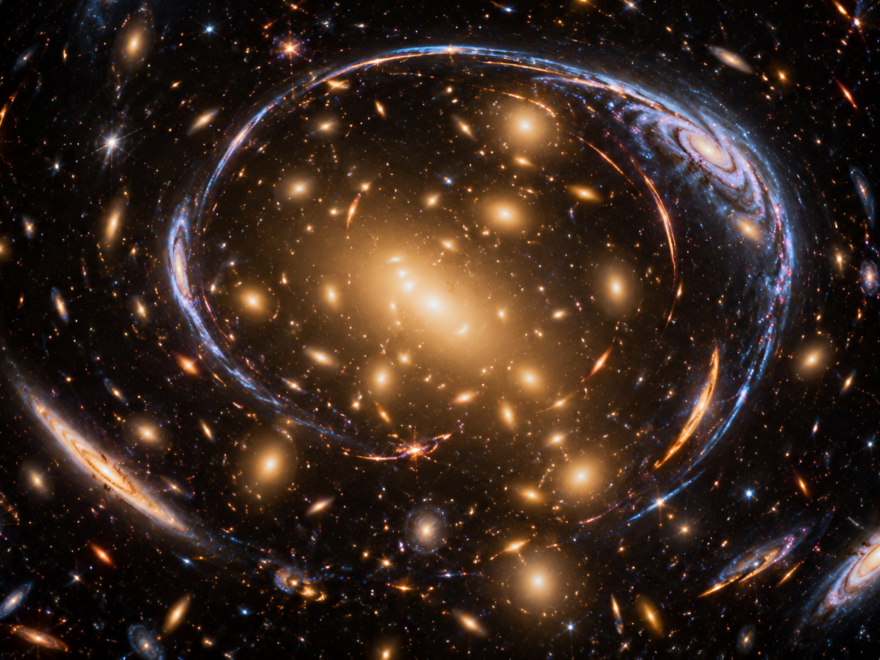
Look at some deep-space photographs and something strange begins to happen.
Most galaxies look roughly like what you would expect: glowing spirals, fuzzy elliptical shapes, or tiny distant points.
Then there are the weird ones.
A galaxy appears stretched into a long luminous arc.
Another seems curved around a completely different galaxy.
Sometimes several nearly identical objects appear in different positions around the same patch of sky.
And occasionally, light forms something close to a ring.
At first glance, it looks as though the telescope has distorted the image.
But the telescope may be recording something real.
There might be only one distant galaxy producing the light.
What changed was the journey that light took before reaching us.
The phenomenon is called gravitational lensing, and it gives astronomers something extraordinary: a natural telescope created not from glass and mirrors, but from gravity itself.
Gravity Can Change the Path of Light
We often learn gravity by thinking about falling objects.
Drop a ball.
It falls toward Earth.
Planets remain in orbit around stars.
Moons orbit planets.
But in Einstein’s description of gravity, massive objects affect the geometry of spacetime itself.
Light traveling through that curved spacetime follows the available path.
Put a sufficiently massive object between us and a distant source of light, and the path reaching our telescope can therefore be bent.
That foreground object becomes a gravitational lens.
Imagine Looking at a Galaxy Behind Another Galaxy
Picture three things arranged across an enormous distance.
First, Earth.
Far away from Earth is a massive galaxy.
Much farther behind that galaxy is another galaxy.
The distant galaxy emits light in many directions.
Some of that light travels toward us.
But before reaching Earth, it passes through the region around the foreground galaxy.
The foreground galaxy’s mass curves spacetime.
The path of the background light bends.
By the time the light reaches our telescope, its apparent origin may no longer look straightforward.
The result can be a distorted image of the distant galaxy.
The Foreground Galaxy Is Not Literally Made of Glass
The word “lens” can create the wrong mental picture.
A gravitational lens is not a transparent glass object floating through space.
Nothing needs to physically refract light the way a camera lens does.
The analogy describes the observational result.
Gravity changes the path of light in a way that can focus, distort, and magnify what we see.
The universe itself is doing the optical trick.
Alignment Determines What We See
Not every gravitational lens produces a spectacular ring.
Geometry matters.
Consider:
The observer.
The foreground mass.
The background source.
Their relative alignment affects the final image.
If the alignment is imperfect, a background galaxy may appear as stretched arcs.
Under other arrangements, multiple images may appear.
With sufficiently symmetrical alignment, the light can form a ring-like image around the foreground lens.
That famous configuration is known as an Einstein ring. ESA describes it as the result of a background galaxy, lensing galaxy, and observer becoming closely aligned. esa.int
An Einstein Ring Is Not a Ring-Shaped Galaxy
This distinction is important.
Imagine seeing a bright circle surrounding a foreground galaxy.
It is tempting to think:
“That distant object must actually look like a ring.”
Not necessarily.
The ring can be a distorted image created by lensing.
Light from the background source reaches the observer along different paths around the foreground mass.
When the geometry is favorable, those distorted images can join into something resembling a complete circle.
Change the alignment and the ring may become incomplete arcs instead.
One Object Can Appear More Than Once
This gets even stranger.
A gravitational lens can create multiple apparent images of the same background object.
Imagine light leaving one quasar.
Different portions of that light travel along different curved paths around an intervening mass.
Several paths eventually reach Earth.
The observer may therefore see several images even though only one original source exists.
NASA has documented examples in which gravitational lensing produces multiple images of a single distant quasar. NASA Science
The sky can effectively contain cosmic duplicates that are not duplicates at all.
Those Multiple Images Are Not Necessarily Identical
If several images come from the same source, you might expect perfect copies.
But lensing can stretch, magnify, rotate, brighten, or otherwise distort the apparent images differently.
The light paths can also have different lengths and pass through different gravitational environments.
That means each image can provide somewhat different observational information about the same source.
Astronomers can use those differences rather than treating them as annoying imperfections.
Light Can Take Different Amounts of Time to Reach Us
Suppose the same distant event is visible through multiple gravitationally lensed images.
The paths followed by the light are not necessarily equivalent.
One route may take longer than another.
As a result, the same astronomical event can potentially appear at different times in different lensed images.
Imagine watching a cosmic event happen in one image and then observing another delayed view through a different light path.
Gravity has effectively given astronomers several routes through which information from the same source arrives.
Galaxy Clusters Can Become Enormous Natural Lenses
A single galaxy can produce lensing.
But galaxy clusters are particularly impressive.
A cluster can contain enormous amounts of mass, including not only visible stars and gas but also dark matter.
That mass can significantly distort light from galaxies far behind the cluster.
In telescope images, background galaxies may appear as long curved streaks surrounding the cluster.
These arcs are not decorative features of the foreground cluster.
They are distant objects whose light has been reshaped on its journey toward us.
Gravitational Lensing Can Make Faint Objects Easier to See
Distortion sounds like a disadvantage.
Usually, when an image becomes distorted, we assume information has been lost.
Gravitational lensing can do something more useful.
It can magnify background sources.
A galaxy that would otherwise be extremely faint may become bright enough for astronomers to detect and study because an intervening mass amplifies its light. NASA describes massive clusters as natural magnifying glasses that can reveal objects otherwise too distant and faint to observe easily. NASA Science
The obstruction becomes an advantage.
The Universe Provides Part of the Telescope
Astronomers build increasingly powerful observatories because distant objects are difficult to detect.
But there is a limit to what any telescope can collect on its own.
Gravitational lensing creates an unusual partnership.
A telescope gathers the light arriving at Earth.
A massive foreground object has already magnified that light during its journey.
Scientists can combine sophisticated observatories with these natural cosmic lenses to investigate objects at enormous distances.
It is almost like discovering that the universe placed an extra magnifying element in front of the telescope.
This Is Especially Useful for Studying the Distant Universe
Looking far away in astronomy also means looking into the past.
Light takes time to travel.
The farther away an object is, the older the light we receive from it.
Very distant galaxies can therefore show us earlier stages of cosmic history.
The problem is that extreme distance also makes them faint and difficult to study.
Gravitational magnification can help bridge that observational gap.
This makes lensing valuable for studying galaxies that existed when the universe was much younger.
Lensing Can Reveal Individual Distant Stars
Normally, separating an individual star at an enormous cosmological distance would be extremely difficult.
A galaxy contains vast numbers of stars whose combined light blends together.
But under exceptional lensing conditions, magnification can become powerful enough to make an individual distant star detectable.
NASA notes that gravitational lenses have helped observatories study extremely distant individual stars as well as galaxies and supernovae. NASA Science
A phenomenon that distorts the sky can therefore expose details we might otherwise never see.
Strong Lensing Produces the Dramatic Images
The most visually obvious examples are generally called strong gravitational lensing.
This is where the distortion becomes easy to recognize.
Arcs.
Multiple images.
Einstein rings.
These effects typically involve substantial foreground masses and favorable alignments.
If you have seen a space photograph with strange curved galaxies surrounding a massive cluster, strong lensing is probably what made the image memorable.
But gravitational lensing does not always look dramatic.
Weak Lensing Is Much More Subtle
Sometimes the distortion of an individual background galaxy is too small to recognize confidently.
One galaxy might naturally have an unusual shape.
Another might simply be tilted.
So astronomers examine large populations.
If many background galaxies show tiny systematic distortions associated with foreground mass, researchers can analyze those patterns statistically.
This is called weak gravitational lensing.
It lacks the visual drama of a giant Einstein ring.
Scientifically, however, it is extremely powerful.
Weak Lensing Can Help Map Invisible Mass
Here is where the story becomes especially interesting.
Dark matter does not emit light in the ordinary way that stars do.
So how can astronomers study something they cannot directly see?
Gravity.
If invisible mass bends light from background galaxies, the distortion carries information about where that mass is distributed.
Astronomers can measure lensing patterns and infer the mass responsible for them.
NASA specifically uses gravitational lensing as one method for investigating the distribution of dark matter. NASA Science
In other words, visible light can reveal the gravitational fingerprints of invisible material.
We Are Mapping Something by Watching What It Does to Something Else
This is a recurring idea in astronomy.
Scientists cannot always observe the object of interest directly.
Instead, they measure its effects.
A planet can reveal itself by affecting its star.
A black hole can reveal itself through nearby matter.
Dark matter can reveal itself through gravity.
Gravitational lensing fits beautifully into this approach.
Astronomers observe distorted background light.
Then they work backward.
What distribution of mass would create the distortion we see?
The distorted image becomes evidence.
There Is Also Microlensing
Not every gravitational lens involves a giant galaxy or cluster.
Stars can act as lenses too.
When a foreground star passes close to the line of sight toward a more distant star, its gravity can temporarily magnify the background star’s light.
This is called gravitational microlensing.
The stars do not need to physically interact.
They only need the right apparent alignment from our viewpoint.
As that alignment changes, the background star brightens and later returns toward its normal brightness.
Microlensing May Not Produce a Pretty Arc
This is why the name can be confusing.
When people hear gravitational lensing, they often imagine a spectacular warped galaxy.
Microlensing can look very different observationally.
The separate distorted images may be too close together for the telescope to resolve.
Instead, astronomers detect the event through a temporary change in brightness.
The lens announces itself through a light curve rather than a dramatic photograph.
A Planet Can Leave a Small Signature in a Microlensing Event
Suppose the foreground lens is a star.
Now suppose that star has a planet.
The star produces the main lensing effect.
But the planet’s gravity can introduce an additional, shorter disturbance in the observed magnification pattern.
Astronomers can analyze that deviation for evidence of the planet.
NASA notes that microlensing can detect planets in configurations that complement other exoplanet-search techniques. NASA Science
So gravity can help us find worlds that emit no visible light of their own.
The Lens Itself Does Not Need to Be Bright
This is one of microlensing’s interesting advantages.
Some detection methods depend heavily on light from the host star.
Gravitational lensing depends on mass.
An object can influence background light through gravity even if the lens itself is faint.
That opens the possibility of studying populations that are difficult to investigate using brightness alone.
Again, astronomy turns an indirect effect into a measurement tool.
Black Holes Can Produce Lensing Too
A black hole is an extreme concentration of mass.
Its gravitational influence can bend passing light.
But there is an important distinction between ordinary gravitational lensing and the dramatic visualizations people often associate with black holes.
Light passing sufficiently far from a black hole can be deflected and continue toward an observer.
Light crossing the event horizon cannot escape.
Around the black hole, these effects can create complex apparent structures depending on the source and geometry.
The underlying principle remains tied to curved spacetime.
Lensing Does Not Mean Light Is “Pulled Sideways” Like a Ball
A common mental model imagines a beam of light flying past a massive object and being tugged sideways by an invisible force.
That picture can be useful at a very basic level, but general relativity gives a deeper description.
Mass changes spacetime geometry.
Light follows paths through that geometry.
So when astronomers say gravity bends light, they are describing the observed curved trajectory through spacetime rather than treating photons like ordinary balls being yanked off course.
That distinction is part of what makes gravitational lensing so conceptually fascinating.
The Sun Can Bend Starlight Too
The basic effect is not restricted to distant galaxy clusters.
The Sun has mass.
Its gravity also affects the path of light passing nearby.
Historically, observations during the 1919 total solar eclipse were used to measure the apparent positions of stars near the Sun and test the light-deflection prediction associated with general relativity. NASA’s historical overview describes eclipse expeditions to Príncipe and Sobral as an important early observational test. NASA Science
Modern gravitational lensing astronomy takes that same underlying physics and applies it across enormous cosmic distances.
Why Don’t We See Lensing Everywhere?
Technically, mass is everywhere.
So why isn’t every star stretched into an arc?
Because the strength and visibility of the effect depend on factors such as mass, geometry, distances, and alignment.
A spectacular strong-lensing system requires a useful arrangement between source, lens, and observer.
Most lines of sight do not produce giant obvious rings.
Many lensing effects are subtle.
Some require precise measurements or statistical analysis to detect.
The universe contains gravitational lenses everywhere, but it does not arrange all of them into postcard-quality images.
More Mass Generally Means More Lensing Power
A galaxy cluster can contain far more mass than a single star.
That makes clusters particularly effective for producing large-scale strong lensing.
But visible mass is not the whole story.
Dark matter contributes substantially to the gravitational field of galaxies and clusters.
Therefore, lensing can reflect the total mass distribution rather than merely the luminous material visible in a photograph.
This is why lensing is so valuable for astrophysics.
Gravity responds to mass whether or not that mass shines.
The Shape of the Lens Matters Too
Two foreground objects with the same total mass do not necessarily create identical lensing patterns.
How the mass is distributed matters.
A compact mass distribution affects spacetime differently from a more extended one.
Substructures inside a galaxy cluster can alter the lensing pattern.
Astronomers therefore model not only how much mass exists but also where that mass is located.
The strange shapes in the background can become clues to the architecture of the foreground system.
Distance Is Part of the Geometry
Mass alone does not determine the result.
The distances among observer, lens, and source also influence lensing.
A massive object in the wrong configuration may produce a less useful effect than another object with a more favorable geometry.
This is why astronomers need accurate models.
They are solving a three-dimensional cosmic arrangement using light that finally reaches us on Earth.
The apparent distortion on the sky contains information about that geometry.
Lensing Can Magnify Without Giving a Perfect Image
Magnification sounds like zooming into a photograph.
But gravitational magnification is not necessarily clean.
The source can become brighter while also being stretched and distorted.
This means astronomers cannot simply treat a lensed galaxy as though somebody increased the zoom slider.
They often need mathematical models to reconstruct what the source probably looks like without the lensing distortion.
The lens gives additional information, but decoding it requires work.
Scientists Can Try to Reconstruct the Original Galaxy
Imagine seeing a face reflected in a curved mirror.
The reflection is distorted.
If you understand the shape of the mirror, you can attempt to determine what the original face looked like.
Gravitational lens modeling works with a related idea.
Researchers model the foreground mass.
They calculate how that mass should bend background light.
Then they use the observed arcs or multiple images to infer properties of the original source.
The warped image becomes a puzzle that can be mathematically reversed.
Lensing Can Help Measure Mass
Normally, measuring the mass of a distant astronomical object is difficult.
You cannot put a galaxy on a scale.
But mass reveals itself through gravity.
If a foreground object bends background light by a measurable amount, astronomers can use that deflection to constrain its mass.
This works even when some of that mass is invisible.
The universe provides a gravitational scale.
The background light is what lets us read it.
A Beautiful Space Image Can Therefore Be a Measurement
This is easy to forget.
A telescope image may look like art.
Curved blue arcs around golden galaxies.
A near-perfect ring.
Several bright points arranged around a foreground galaxy.
But those shapes are data.
Their positions matter.
Their curvature matters.
Their brightness matters.
Their relationship to the foreground mass matters.
Astronomers can extract physical information from features that initially look like cosmic decoration.
Gravitational Lensing Connects Several Huge Ideas at Once
Few astronomical phenomena bring so many concepts together so elegantly.
General relativity.
Galaxy evolution.
Dark matter.
Exoplanets.
Cosmic distance.
The early universe.
Stellar astronomy.
Observational technology.
One basic principle—mass changing the path of light—becomes a tool across multiple fields of astronomy.
That is what makes gravitational lensing much more than a strange visual effect.
The Distortion Is the Information
Usually, scientists try to remove distortion.
Correct the image.
Calibrate the instrument.
Reduce noise.
With gravitational lensing, the distortion itself contains information.
If a galaxy looks stretched, ask why.
If the same quasar appears four times, ask what geometry produced those images.
If thousands of galaxies show tiny correlated distortions, ask what invisible mass lies in front of them.
Instead of throwing away the weirdness, astronomers measure it.
The Universe Is Not Showing Us a Simple Photograph
When we look into space, it is tempting to imagine that a telescope simply photographs objects exactly where and how they exist.
Reality is more complicated.
Light has traveled.
Space has expanded.
Dust may have absorbed some wavelengths.
Objects have moved.
Gravity may have redirected the light.
A deep-space image is therefore not merely a collection of distant objects.
It is also a record of what happened to their light on the journey toward us.
Gravitational lensing makes that journey visible.
Conclusion
Gravitational lensing happens because mass curves spacetime, changing the paths that light can take before reaching an observer.
When a massive galaxy or galaxy cluster sits between Earth and a more distant source, the background object’s light may be magnified and distorted. Depending on the alignment, astronomers can observe arcs, multiple images, or even an Einstein ring.
Smaller-scale microlensing can temporarily magnify background stars and even help reveal exoplanets.
But the real power of gravitational lensing goes beyond producing strange photographs.
It allows astronomers to study objects that would otherwise be too faint, investigate extremely distant galaxies, measure mass, and map matter that does not emit light.
That makes the warped images valuable precisely because they are warped.
So the next time a telescope photograph seems to show the same galaxy more than once, the universe has not necessarily made copies.
You may simply be seeing one source of light taking several different paths through curved spacetime before finally reaching us.