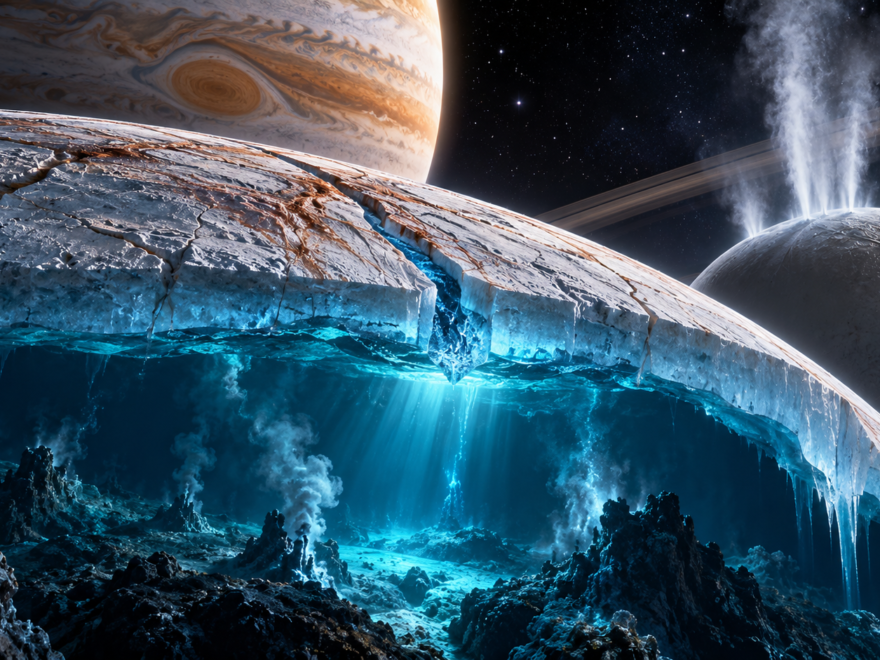
From a distance, they do not look promising.
No forests.
No rivers.
No visible seas.
No breathable atmosphere.
No warm sunlight falling across a landscape that resembles Earth.
Instead, there is ice.
Kilometers of it.
Frozen surfaces scarred by fractures, ridges, craters, and strange geological patterns.
Temperatures are brutally low.
Radiation can be intense.
Sunlight is weak.
If you were asked to imagine the most likely place for life beyond Earth, a frozen moon orbiting a giant planet might not be your first choice.
And yet some of the most intriguing places in the search for extraterrestrial life are exactly these worlds.
Europa around Jupiter.
Enceladus around Saturn.
Ganymede and Callisto.
Perhaps other icy bodies farther from the Sun.
Their surfaces may be frozen, but evidence suggests that some could hide enormous subsurface oceans beneath their icy shells.
That possibility changes almost everything.
Because when scientists search for environments that might support life, they are not necessarily searching for another Earth.
They are searching for the conditions that could allow chemistry to become biology.
And sometimes those conditions may exist where we cannot see them.
The Solar System May Contain More Ocean Than It Appears To
When we think of an ocean world, Earth naturally comes first.
Our planet looks blue from space because liquid water covers most of its surface.
But surface appearance can be misleading.
A world does not need visible oceans to contain enormous quantities of liquid water.
If a moon has a thick outer layer of ice and sufficient heat beneath it, liquid water may persist below the frozen surface.
That creates an extraordinary possibility.
Some of the largest reservoirs of liquid water in the Solar System may be completely hidden.
Ice Does Not Necessarily Mean Everything Beneath It Is Frozen
Imagine a frozen lake in winter.
The surface freezes first because it is exposed to cold air.
Water can remain liquid beneath.
An icy moon operates on a vastly different scale, but the basic idea helps.
A frozen exterior does not prove the entire body is frozen solid.
If enough energy exists inside the moon, deep layers can remain warm enough for liquid water.
The important question therefore becomes:
Where does that energy come from?
Distance From the Sun Is Only Part of the Temperature Story
Earth receives enormous amounts of energy from the Sun.
Move farther outward through the Solar System and sunlight becomes weaker.
That might suggest worlds around Jupiter and Saturn should simply freeze completely.
But sunlight is not the only source of energy available to a planetary body.
Moons can contain internal heat.
Some of that heat comes from radioactive decay within rocky material.
But around giant planets, another mechanism can become extremely important.
Gravity itself.
A Giant Planet Can Literally Flex a Moon
Europa does not travel through space alone.
It orbits Jupiter, the largest planet in our Solar System.
Jupiter’s gravitational pull is enormous.
Europa’s orbit is not perfectly circular.
As its distance from Jupiter changes slightly during its orbit, the gravitational forces acting on the moon also vary.
The result is deformation.
Europa is repeatedly stretched and compressed.
This process is known as tidal flexing.
Tidal Flexing Can Produce Heat
Take a flexible object and repeatedly bend it.
The material experiences internal friction.
Something conceptually similar can happen inside a moon.
Gravitational forces continuously deform its interior.
That mechanical energy can be converted into heat.
Over geological timescales, tidal heating can be significant.
Enough internal heating may prevent all of the moon’s water from freezing.
This means a moon located hundreds of millions of kilometers from the Sun can potentially maintain a liquid ocean.
Not because sunlight keeps it warm.
Because gravity does.
Europa Is One of the Most Compelling Examples
Europa is slightly smaller than Earth’s Moon.
Its surface is extraordinarily bright and icy.
Long fractures cross the landscape.
Dark reddish-brown material appears along some cracks and disrupted regions.
Large impact craters are relatively uncommon compared with many other moons.
That suggests the surface is geologically young.
Something has been reshaping it.
One explanation involves movement within the ice shell above a global ocean.
The Surface Looks Almost Like Broken Ice
Some regions of Europa contain blocks of ice that appear to have shifted, rotated, and refrozen.
These areas are sometimes called chaos terrain.
Imagine pieces of a frozen surface breaking apart and moving relative to one another before becoming locked into new positions.
The scale is enormous.
Scientists study these patterns because they may provide clues about what is happening beneath the surface.
A dynamic ice shell makes more sense if the material below it can move.
Scientists Cannot Simply See Europa’s Ocean
There is no giant transparent window through the ice.
So how can anyone argue that an ocean exists?
Planetary science often works indirectly.
Researchers combine multiple kinds of evidence.
Surface geology.
Gravity.
Magnetic measurements.
Orbital behavior.
Models of the moon’s interior.
Possible water-vapor observations.
No single observation needs to carry the entire argument.
Instead, different pieces can point toward the same underlying structure.
Magnetic Fields Can Reveal an Invisible Ocean
Europa travels through Jupiter’s powerful magnetic environment.
Measurements made by spacecraft showed magnetic behavior consistent with an electrically conductive layer inside Europa.
Liquid water containing dissolved salts could provide such conductivity.
In other words, scientists may be able to infer an ocean without seeing the water directly.
The ocean interacts indirectly with Jupiter’s magnetic field.
Physics becomes a way of looking through ice.
Salt Makes the Story Even More Interesting
Pure water is not particularly conductive.
Dissolved ions change that.
If Europa’s hidden ocean contains salts, it could behave electrically in ways detectable by spacecraft instruments.
This also raises questions about ocean chemistry.
What minerals might be dissolved?
Does water interact with rock below?
Could material from the ocean reach the ice above?
Could surface material eventually reach the ocean?
Those questions matter enormously when considering habitability.
Water Alone Is Not Enough for Life
This distinction is crucial.
Finding water does not mean finding life.
Life as we know it requires more than H₂O.
It requires chemistry.
Useful elements.
Sources of energy.
Conditions stable enough for complex reactions.
Potentially long periods of time.
A perfectly sterile ocean is entirely possible.
So astrobiologists do not simply ask:
“Is there water?”
They ask:
“What kind of environment does that water create?”
Liquid Water Is Still an Excellent Starting Point
Every known organism on Earth depends on liquid water.
That makes water a logical target in the search for potentially habitable environments.
Water is an extraordinary solvent.
Many chemical reactions important to biology can occur within it.
Molecules can move.
Dissolve.
Interact.
React.
Transport materials.
An ocean therefore provides a potentially useful medium for complex chemistry.
But habitability depends on what else is present.
The Seafloor May Be More Important Than the Surface
Suppose Europa really does contain a global ocean.
What lies underneath?
Potentially a rocky interior.
That boundary between water and rock could be scientifically fascinating.
Water-rock interactions can generate chemical gradients.
Minerals can dissolve.
Reactions can release compounds that microorganisms might theoretically exploit.
If geological activity occurs at the seafloor, the environment becomes even more interesting.
Earth Provides a Powerful Comparison
For a long time, it was easy to imagine that nearly all ecosystems ultimately depended on sunlight.
Plants capture sunlight.
Animals eat plants.
Other animals eat those animals.
Simple.
Then scientists discovered thriving ecosystems around hydrothermal vents deep in Earth’s oceans.
These places receive no sunlight.
Yet life flourishes.
Hydrothermal Vents Changed How We Think About Habitable Worlds
At hydrothermal vents, seawater interacts with hot rock beneath the seafloor.
Chemical reactions produce energy-rich compounds.
Microorganisms can use chemical energy instead of sunlight.
This process is associated with chemosynthesis.
Entire ecosystems can develop around these microorganisms.
The discovery demonstrated something profound.
An ecosystem does not necessarily need sunlight at the point where it lives.
It needs an accessible source of energy.
That Makes Dark Alien Oceans Much More Interesting
A hidden ocean beneath kilometers of ice would receive little or no sunlight.
At first, that sounds devastating for life.
But Earth’s deep ocean demonstrates that darkness alone does not eliminate biological possibilities.
If chemical energy is available at the seafloor of an icy moon, sunlight may not be essential.
This is one reason scientists are so interested in whether Europa’s ocean contacts rock.
Water plus rock plus energy creates a much more compelling environment than water alone.
But Europa Has a Serious Problem: Radiation
Jupiter’s magnetic field traps high-energy particles.
Europa orbits inside an intense radiation environment.
Its surface receives radiation levels that would be extremely hostile to familiar life.
That sounds like terrible news.
For surface organisms, it probably would be.
But the ocean is not on the surface.
Ice Can Act as a Shield
A thick layer of ice between the surface and ocean can block much of the harmful radiation.
This creates an unusual situation.
The same ice that makes Europa difficult to explore may help protect its ocean.
The surface can be hostile.
The interior can potentially be much more stable.
Habitability does not need to describe an entire world.
It can exist in a specific environment within that world.
Europa Teaches Us to Stop Judging Worlds by Their Surfaces
Earth trains our intuition badly.
We live on the surface.
So we naturally inspect alien surfaces first.
Does it have lakes?
Rivers?
Vegetation?
Clouds?
But another world may place its most habitable environment underground.
A planet or moon could look completely lifeless from orbit while hiding an enormous liquid environment underneath.
This expands the geography of the search for life.
Then There Is Enceladus
If Europa is fascinating, Enceladus may be even stranger.
Enceladus is a small moon of Saturn.
It is only about 500 kilometers across.
For a body this small and distant from the Sun, you might expect a frozen, geologically quiet world.
Instead, Enceladus is active.
Very active.
Something Is Erupting From Its South Pole
Spacecraft observations revealed enormous plumes emerging from fractures near Enceladus’s south polar region.
Water vapor.
Ice particles.
Other compounds.
Material is being blasted into space.
Some of it contributes to Saturn’s E ring.
This is astonishing because Enceladus is effectively delivering samples of its interior into space.
Scientists do not necessarily need to drill through the ice to examine material connected to the hidden ocean.
The moon is throwing some of it outward.
Those Fractures Have an Appropriate Nickname
Long, roughly parallel fractures cross Enceladus’s south polar terrain.
They are commonly known as tiger stripes.
These fractures are warmer than surrounding regions.
Jets emerge from them.
Their behavior appears connected to tidal forces as Enceladus orbits Saturn.
Again, gravity is helping keep a distant icy moon geologically active.
Enceladus Also Appears to Have a Global Ocean
Early interpretations considered whether liquid water might exist mainly beneath the south pole.
Later evidence supported something more dramatic.
A global ocean beneath the icy crust.
The moon’s slight wobble as it rotates is difficult to explain if the outer ice shell is rigidly attached all the way to the interior.
A liquid layer allows the shell to move differently.
Once again, motion reveals what cannot be seen directly.
Cassini Flew Through the Plumes
This is one of the most remarkable chapters in planetary exploration.
The Cassini spacecraft did not merely photograph Enceladus’s plumes.
It passed through them.
Its instruments analyzed particles and gases.
That allowed scientists to investigate material emerging from the moon without landing.
Imagine trying to understand an ocean buried beneath ice.
Then imagine that ocean spraying samples into space where your spacecraft can collect information from them.
Enceladus provides exactly that opportunity.
The Plumes Contain More Than Water
Measurements detected water vapor and various other compounds.
Organic molecules were found.
Molecular hydrogen was detected.
Phosphorus has also been identified in material originating from Enceladus.
None of this proves life exists there.
But these findings make the moon’s chemistry much more interesting.
The hidden ocean is not simply a giant reservoir of chemically pure water.
Molecular Hydrogen Was Particularly Interesting
Hydrogen can be produced through reactions between water and certain rocks.
On Earth, processes involving water-rock interactions can generate molecular hydrogen.
Some microorganisms can use hydrogen as an energy source.
Therefore, detecting hydrogen associated with Enceladus raises the possibility that chemically useful energy is being produced inside the moon.
Again:
Possible energy source.
Not evidence of organisms.
That distinction matters.
Scientists Are Looking for Habitability Before Life
Astrobiology often progresses in stages.
First:
Could liquid water exist?
Then:
What is the chemistry?
Then:
Is there an energy source?
Then:
Are biologically important elements available?
Then:
Could these conditions remain stable?
Only after establishing environmental plausibility does the question of life become stronger.
This cautious sequence prevents an interesting molecule from immediately becoming an alien headline.
Organic Molecules Do Not Automatically Mean Biology
The word “organic” causes confusion.
In chemistry, organic molecules are generally carbon-containing compounds.
They can be produced biologically.
They can also form without life.
Meteorites contain organic compounds.
Interstellar environments contain carbon chemistry.
Planetary processes can create complex molecules.
Therefore:
Organic chemistry is interesting.
It is not proof of biology.
The Same Caution Applies to Methane
Methane can be produced by organisms.
It can also be produced geologically.
If methane is detected somewhere beyond Earth, scientists need context.
How much?
Where?
Is it changing?
What other compounds are present?
What geological processes could create it?
A potential biosignature becomes convincing only when plausible non-biological explanations are carefully evaluated.
Searching for Life Is Really a Search for Patterns
A single molecule may be ambiguous.
Several related observations can become more informative.
Imagine finding:
A certain chemical imbalance.
Multiple compounds associated with metabolism.
Patterns difficult to maintain geologically.
Structures resembling cells.
Isotopic ratios consistent with biological processing.
Even then, extraordinary caution would be required.
The strongest case would come from independent lines of evidence pointing toward the same explanation.
Contamination Is a Huge Problem
Suppose a spacecraft travels from Earth to an icy moon.
Earth is covered in microorganisms.
Some are extremely resilient.
If even a tiny amount of terrestrial biological material contaminates an instrument, future measurements could become confusing.
Did we detect alien biology?
Or did we detect ourselves?
Planetary protection exists partly because this question would be scientifically disastrous.
We Must Avoid Bringing Earth Life to Potentially Habitable Worlds
The ethical and scientific stakes are enormous.
If Europa or Enceladus contains an independent biosphere, introducing terrestrial microorganisms could compromise it.
Even if Earth organisms could not survive there, contamination could interfere with measurements.
Spacecraft intended for sensitive astrobiology missions therefore require extremely careful contamination control.
The cleaner the experiment, the stronger the conclusion.
We Also Have to Protect Earth When Samples Return
The opposite direction matters too.
If material from a potentially habitable environment were returned to Earth, scientists would need protocols for handling it safely and preserving its scientific integrity.
This does not mean alien microbes are expected to be dangerous.
We simply do not know.
Responsible exploration requires planning for uncertainty.
Europa Is Harder to Sample Than Enceladus
Enceladus conveniently ejects ocean-related material into space.
Europa may have possible plume activity, but the situation is less straightforward.
Its thick ice presents a major engineering challenge.
Reaching the ocean directly could require penetrating kilometers of ice depending on location and shell structure.
That is far beyond simply landing and drilling a shallow hole.
A Cryobot Sounds Like Science Fiction Because It Almost Is
One proposed concept for exploring deep ice is a cryobot.
Imagine a robotic probe designed to melt its way downward.
It carries instruments.
Potentially deploys a communication tether.
Slowly descends through the ice.
Eventually reaches liquid water.
Then perhaps releases a small underwater vehicle.
Conceptually, it is beautiful.
Engineering it is extraordinarily difficult.
Melting Through Alien Ice Creates Problem After Problem
Where does the energy come from?
How does the probe avoid becoming trapped?
How does it communicate through kilometers of ice?
How do instruments remain sterile?
What if the ice contains unexpected layers?
What if the hole refreezes?
How does the system survive high pressure?
How long does descent take?
How much mass can a spacecraft realistically carry from Earth?
Every solution creates additional engineering requirements.
The Ice Shell Itself May Be Scientifically Valuable
Fortunately, scientists do not necessarily need to reach the ocean immediately.
The ice may contain material transported from below.
Fractures may expose younger deposits.
Surface chemistry may reveal interactions between the ocean and crust.
Radar can probe internal structure.
Magnetic measurements can constrain ocean properties.
Gravity measurements can reveal interior mass distribution.
There are many ways to investigate a hidden ocean before physically entering it.
Radar Can Turn Ice Into a Scientific Window
Radar waves can penetrate materials that visible light cannot.
Different layers and structures reflect radar differently.
This makes ice-penetrating radar extremely useful for studying frozen worlds.
Researchers can potentially investigate:
Ice thickness.
Internal layers.
Buried structures.
Possible pockets of liquid water.
Connections between surface geology and deeper regions.
The ocean may remain invisible to cameras while becoming partially visible to physics.
Gravity Can Reveal Hidden Layers Too
A spacecraft passing near a moon experiences tiny changes in motion caused by the moon’s gravity.
Carefully measuring those changes can reveal information about how mass is distributed internally.
Different interior structures produce different gravitational signatures.
Combined with magnetic and geological evidence, these measurements help scientists build models of what lies beneath the surface.
We cannot cut Europa open.
So we infer its anatomy.
The Moon’s Shape Can Tell Us About Its Interior
How a moon deforms under gravitational forces depends partly on its internal structure.
A completely rigid body responds differently from one containing liquid layers.
By studying tides, rotation, and shape changes, scientists can constrain interior models.
This is one of the elegant features of planetary science.
A world’s movement becomes an instrument for studying its hidden interior.
Ganymede Complicates the Picture Further
Europa is not Jupiter’s only possible ocean world.
Ganymede, the largest moon in the Solar System, also appears to contain a deep ocean.
But its internal structure may be more complicated.
Researchers have considered models involving multiple layers of ice and liquid water at enormous pressures.
This raises a fascinating question.
Does an ocean remain equally interesting for life if high-pressure ice separates the water from the rocky seafloor?
Rock-Water Contact Could Matter Enormously
If liquid water directly contacts rock, chemical reactions can occur at the boundary.
Those reactions may provide useful chemical ingredients and energy gradients.
If a thick layer of high-pressure ice separates ocean from rock, the chemistry could be different.
This does not automatically make life impossible.
But it changes the environment.
“Has an ocean” is therefore not enough information.
We need to know the ocean’s architecture.
Callisto May Hide an Ocean Too
Callisto is another large moon of Jupiter.
Its heavily cratered surface looks ancient and relatively inactive.
Yet magnetic evidence has supported the possibility of a conductive layer beneath the surface, potentially a salty ocean.
If true, that creates an interesting contrast with Europa.
Two moons can both contain subsurface oceans while having very different geological histories.
One appears active.
The other looks ancient and quiet.
Habitability may depend on those differences.
Even Tiny Worlds Can Surprise Us
Enceladus changed expectations partly because of its size.
Small worlds were once easier to imagine as geologically dead.
They should lose internal heat relatively quickly.
But tidal forces can rewrite that expectation.
A moon does not exist in isolation.
Its orbit matters.
Its planet matters.
Neighboring moons matter.
Orbital resonances matter.
The entire gravitational system can influence its internal evolution.
Orbital Resonance Can Keep Heating Going
Moons gravitationally interact with one another.
Certain orbital relationships can prevent an orbit from becoming perfectly circular.
That maintains changing tidal forces.
Changing tidal forces maintain flexing.
Flexing generates heat.
Heat helps maintain liquid water.
A chain of orbital mechanics can therefore influence whether an ocean exists beneath ice.
Life-related questions can begin with celestial mechanics.
Habitability Is a System, Not a Checklist
It is tempting to create a simple formula:
Water + carbon + energy = life.
Reality is more complicated.
Concentrations matter.
Temperature matters.
Pressure matters.
Chemical balance matters.
Stability matters.
Time matters.
Transport between environments matters.
Too little energy can be a problem.
Too much geological activity can also be disruptive.
Habitability emerges from interactions.
Life Also Needs Usable Energy, Not Merely Energy
A moon can contain enormous amounts of heat.
That does not mean organisms can use it directly.
Biology depends on energy gradients and chemical reactions that can drive metabolism.
The difference matters.
An environment may be energetic while lacking accessible pathways that life can exploit.
Astrobiologists therefore study chemistry alongside geophysics.
Chemical Disequilibrium Can Be Interesting
Systems naturally tend toward equilibrium.
Life can maintain chemical states that would otherwise change.
On Earth, the atmosphere itself contains combinations of gases influenced strongly by biology.
In an alien ocean, researchers might search for chemical patterns that suggest continuous processes.
But geological reactions can also maintain disequilibrium.
Again, context determines interpretation.
The Origin of Life May Be Harder Than Sustaining Life
This is an important distinction.
An environment might be capable of supporting organisms if organisms were somehow placed there.
That does not mean life could originate there.
The chemical pathway from nonliving matter to the first self-replicating biological systems remains one of science’s deepest unresolved questions.
Habitability and origin-of-life potential overlap.
They are not identical.
Europa Could Be Habitable Without Ever Having Developed Life
Imagine Europa has:
Liquid water.
Useful chemistry.
Energy.
A rocky seafloor.
Long-term stability.
Even then, the ocean could be sterile.
Maybe the origin of life requires rare conditions.
Maybe life emerges easily wherever conditions allow.
We currently have only one confirmed example.
Earth.
With a sample size of one, probability is extremely difficult to estimate.
Finding No Life Would Still Be an Extraordinary Discovery
Suppose future missions establish that Europa’s ocean is chemically rich and habitable.
Then they search carefully.
Nothing.
That result would matter enormously.
It could suggest that habitability alone is insufficient.
Perhaps the transition from chemistry to biology is difficult.
Perhaps additional conditions are required.
A sterile but habitable ocean would still teach us about the rarity or difficulty of life’s emergence.
Finding Independent Life Would Change Biology Forever
Now imagine the opposite.
Scientists find compelling evidence of organisms.
Then establish that they originated independently from Earth life.
That would immediately answer one of humanity’s oldest questions.
Life is not unique to Earth.
But the deeper implications would be even larger.
We could compare two independent biological systems.
Do they both use DNA?
Proteins?
Cell membranes?
Similar genetic codes?
Completely different chemistry?
For the first time, biology would have more than one example of life.
Two Origins Would Suggest Something Profound
If life originated independently on Earth and on a small moon around Jupiter or Saturn, that would imply biology emerged at least twice within one planetary system.
It would not prove the universe is full of life.
But it would dramatically change the conversation.
Life might be a recurring consequence of suitable chemistry rather than an almost impossible accident.
One alien microbe could reshape our understanding of the cosmos.
Alien Life Might Be Extremely Boring to Look At
Movies prepare us for creatures.
Tentacles.
Eyes.
Spaceships.
Signals.
Reality may be microscopic.
A membrane.
A chemical cycle.
A simple organism dividing slowly in dark water.
No intelligence.
No civilization.
No dramatic appearance.
Yet scientifically, one independently evolved microbe could be more important than almost any fictional alien encounter.
Complexity is not what makes alien life revolutionary.
Independence is.
It May Not Even Look Like a Cell We Recognize
Searching for unfamiliar biology creates a difficult problem.
Our instruments are designed by Earth organisms looking for patterns familiar from Earth.
But alien life might organize itself differently.
Different molecules.
Different membrane chemistry.
Different information storage.
Different metabolic pathways.
Researchers therefore face a balancing act.
Search for signatures we know biology can produce without assuming all biology must resemble us.
This Is Why Biosignatures Are So Difficult
A biosignature is evidence that may indicate biological activity.
But “may indicate” is doing important work.
Nature produces surprising chemistry without organisms.
Minerals can create structures that look biological.
Geological reactions can produce gases associated with metabolism.
Complex organic molecules can form abiotically.
The more extraordinary the claim, the more alternative explanations need to be eliminated.
Context Is Everything
Suppose an instrument detects an organic molecule.
Interesting.
Where was it found?
What temperature?
What minerals are nearby?
Could radiation produce it?
Could water-rock reactions produce it?
How quickly would it break down?
Is it replenished?
Are related compounds present?
Scientific interpretation lives in these surrounding questions.
A molecule alone rarely tells the whole story.
Samples Would Be More Powerful Than Remote Measurements
Remote sensing is extraordinary.
Flybys can transform our understanding.
Orbiters can map worlds.
But laboratory analysis on Earth can achieve levels of precision and flexibility difficult to reproduce on spacecraft.
That is why sample return is so scientifically valuable.
A returned sample can be studied by many laboratories using different instruments.
And future scientists can reanalyze it with technologies that do not exist today.
Enceladus Offers a Tempting Sample-Return Possibility
Because material is already escaping into space, a spacecraft could theoretically collect plume particles.
It would not need to land.
It would not need to drill.
It would fly through the plume and capture material.
The challenge is preserving the sample and collecting it in ways that do not destroy delicate chemical structures.
Then comes the enormous challenge of returning it safely to Earth.
Simple concept.
Difficult mission.
Flying Through a Plume at High Speed Can Damage Samples
Imagine catching a snowflake while driving extremely fast.
Now increase the speed enormously.
Particles striking collection surfaces can be altered or destroyed.
Delicate molecules may fragment.
Scientists therefore need collection methods and mission trajectories designed to preserve as much information as possible.
Even when an alien moon hands us samples, receiving them properly is difficult.
Landing Creates a Different Set of Problems
A lander can analyze material directly.
But landing requires:
Navigation.
Hazard avoidance.
Power.
Communication.
Thermal management.
Sterility.
Mechanical reliability.
A safe surface.
Long-distance mission operations.
Europa’s radiation environment adds another challenge.
Every extra instrument increases mass and complexity.
Planetary missions are exercises in compromise.
Spacecraft Cannot Carry Every Instrument Scientists Want
Researchers may propose dozens of experiments.
Engineers must fit them within strict limits.
Mass.
Power.
Volume.
Data transmission.
Cost.
Reliability.
Mission duration.
One instrument may require another to be removed.
This means mission design is partly about deciding which questions matter most.
Exploration is constrained curiosity.
Sometimes a Camera Answers a Question Nobody Expected to Ask
Space missions frequently produce surprises.
An instrument designed for one purpose observes something unexpected.
A strange plume.
An unusual terrain.
A chemical signature.
A temperature anomaly.
These discoveries can redirect entire research fields.
This is why broad observational capability matters.
We do not always know the correct question before arriving.
Europa Clipper Is Designed to Study Habitability, Not Land and Find Aliens
One common misunderstanding about missions to ocean worlds is that every mission is directly searching for organisms.
Often the goal is more fundamental.
Characterize the environment.
Study the ice shell.
Investigate composition.
Understand geology.
Constrain ocean properties.
Determine where future missions should look.
Before searching for biology, scientists need a better map of the potential habitat.
Exploration Happens in Layers
First telescopes identify something interesting.
Then spacecraft fly past.
Then orbiters map.
Then landers investigate.
Perhaps eventually drills or cryobots penetrate the surface.
Each generation of missions reduces uncertainty for the next.
We did not begin exploring Mars by immediately attempting to return samples from underground.
Ocean worlds will likely require similarly incremental exploration.
The Ice Thickness Question Changes Mission Design
Suppose Europa’s ice shell is relatively thin in certain regions.
Accessing ocean-related material becomes easier.
Suppose it is extremely thick.
Direct exploration becomes much harder.
Scientists therefore care deeply about ice thickness and internal structure.
A measurement that sounds like pure geophysics can determine whether a future astrobiology mission is practical.
Shallow Water Pockets Could Change Everything
The main ocean may not be the only liquid environment.
Models and geological evidence have raised possibilities of localized liquid reservoirs or briny regions within the ice shell.
If accessible pockets exist closer to the surface, future missions may not need to penetrate all the way to the global ocean to investigate interesting chemistry.
The ice itself may contain smaller environments worth exploring.
Brines Can Stay Liquid Below Normal Freezing Temperatures
Salt lowers the freezing point of water.
That is why salt can help melt ice on roads.
Inside an icy moon, dissolved salts can allow liquid or partially liquid regions to persist at temperatures where pure water would freeze.
This complicates the internal structure.
The boundary between “ice” and “ocean” may not always be clean.
There may be slushy, briny, partially melted regions.
Alien geology rarely respects our simple diagrams.
Pressure Changes the Behavior of Water
Deep inside large icy moons, pressure can become enormous.
Water does strange things under high pressure.
Different crystalline phases of ice can form.
These are not the ordinary ice cubes in your freezer.
Some high-pressure ice phases can exist even at relatively warm temperatures.
This means a large moon may contain layers like:
Ordinary ice.
Liquid ocean.
High-pressure ice.
Rocky interior.
The deeper we go, the less intuitive water becomes.
Not Every Ocean World Is Equally Promising
The phrase “ocean world” sounds automatically exciting.
But scientists need to distinguish between environments.
Does the ocean touch rock?
Is chemical energy available?
How salty is it?
How acidic or alkaline?
How stable?
How old?
Does material circulate?
Can surface oxidants reach deeper water?
Does the moon remain geologically active?
Ocean volume alone cannot answer habitability.
Circulation Could Be Crucial
Earth’s oceans are not static containers.
Currents move heat.
Nutrients.
Dissolved gases.
Particles.
If alien oceans circulate, materials produced at the seafloor could move elsewhere.
Surface-derived chemistry might travel downward.
Energy gradients could develop.
Without circulation, environments may become chemically isolated.
Understanding an extraterrestrial ocean therefore requires oceanography without ever seeing the ocean.
Scientists Can Model Alien Currents
Researchers use physics to simulate how hidden oceans might behave.
Rotation matters.
Heat flow matters.
Salinity matters.
Ice thickness matters.
Seafloor topography may matter.
Tidal forces matter.
Models cannot replace observations.
But they allow scientists to predict what measurements might distinguish one scenario from another.
We can begin doing oceanography on a world where no human has ever seen the water.
The Surface and Ocean May Exchange Material
This possibility is particularly important.
Radiation striking Europa’s surface can produce chemically reactive compounds.
If geological processes transport some of those materials downward, they could provide chemical energy to the ocean.
Meanwhile, ocean material may move upward through fractures or disrupted ice.
If exchange occurs, the surface and ocean are not separate worlds.
They are parts of one chemical system.
That Could Make Surface Sampling Much More Valuable
Suppose material from the ocean occasionally reaches the surface.
A lander may not need to drill kilometers.
It could target relatively young deposits associated with recent geological activity.
Of course, radiation can alter surface chemistry.
So researchers would need to determine how fresh the material is and how much it has changed.
Still, geology may provide shortcuts that engineering cannot.
Young Terrain Is Especially Interesting
A heavily cratered surface usually indicates long exposure.
A smooth or recently resurfaced area may be younger.
If scientists want material that has experienced less radiation and alteration, geologically young regions can become attractive targets.
Choosing a landing site therefore requires balancing:
Scientific value.
Surface age.
Safety.
Terrain.
Communication.
Engineering constraints.
The most interesting location is not always the safest place to land.
Alien Oceans May Be Extremely Deep
Earth’s oceans are deep by human standards.
Some extraterrestrial oceans may be far deeper.
Potentially tens or even more than a hundred kilometers depending on the world and model.
Imagine an ocean where Mount Everest would disappear far beneath the surface.
Pressure at depth would be immense.
Any hypothetical ecosystem would exist under conditions dramatically different from most familiar terrestrial environments.
Yet Earth Life Already Handles Remarkable Pressure
Deep-sea organisms survive pressures that would be fatal to humans.
Their cellular structures and biochemistry are adapted to those environments.
This demonstrates that high pressure alone does not prohibit life.
But alien oceans could reach pressure regimes beyond those inhabited by familiar organisms.
Earth provides analogies.
It does not provide guarantees.
Extremophiles Changed Our Definition of “Normal”
Life exists in acidic environments.
Highly salty water.
Deep rock.
Hydrothermal systems.
Polar ice.
Hot environments.
High-pressure ocean depths.
These organisms are called extremophiles from a human perspective.
For them, the environment is simply home.
Their existence expanded scientific understanding of where life can function.
That expansion directly influences astrobiology.
But Extremophiles Do Not Mean “Life Can Survive Anywhere”
This is an important correction.
Earth organisms are adaptable.
They are not magical.
There are limits.
Temperature can become too high.
Water availability can become too low.
Radiation can overwhelm repair mechanisms.
Chemistry can become incompatible with cellular function.
Finding life in extreme environments expands the known habitable range.
It does not eliminate boundaries.
Earth Is Our Laboratory for Alien Possibilities
Scientists study Antarctica.
Deep oceans.
Subglacial lakes.
Hydrothermal vents.
Highly saline environments.
Deep subsurface rock.
Not because these locations are identical to Europa or Enceladus.
They are not.
They provide natural laboratories for studying how organisms and chemistry behave under conditions relevant to questions about other worlds.
Analogs are useful precisely because we cannot yet visit alien oceans directly.
Antarctica Offers an Obvious Comparison
Ice.
Darkness.
Cold.
Water beneath frozen surfaces.
These similarities make Antarctic environments scientifically valuable analogs.
Researchers can test instruments.
Study contamination.
Investigate microbial survival.
Understand ice dynamics.
But even Antarctica is warm and accessible compared with Europa.
Every analogy has limits.
Earth’s Deep Biosphere Is Equally Fascinating
Life exists beneath Earth’s surface, sometimes far removed from sunlight.
Microorganisms can inhabit rock pores and underground fluids.
Their metabolism can operate slowly.
Energy availability may be extremely low.
These ecosystems demonstrate that life can persist in environments very different from the surface biosphere we experience daily.
An alien biosphere might be similarly hidden and slow.
Alien Life May Operate on Timescales We Find Difficult to Detect
Imagine microorganisms with extremely slow metabolism.
They divide rarely.
Consume tiny amounts of energy.
Produce subtle chemical changes.
A spacecraft might sample the environment briefly and miss them.
Detection strategies must therefore account for the possibility that alien ecosystems are sparse.
Life does not need to produce forests to exist.
We May Need to Search for Chemistry Rather Than Organisms
A microscope looking for moving cells is intuitive.
But extraterrestrial life detection may depend more heavily on chemistry.
Patterns of molecules.
Molecular complexity.
Isotopic signatures.
Chemical gradients.
Structures associated with self-organization.
The goal is to identify processes that are difficult to explain without biology.
That can be much harder than simply seeing something swim past a camera.
False Positives Could Be Historic Disasters
Imagine announcing extraterrestrial life.
Headlines spread worldwide.
Textbooks begin changing.
Then a year later researchers discover the signal came from contamination or unexpected geology.
The reputational and scientific consequences would be enormous.
That is why researchers are cautious.
Multiple instruments.
Independent analyses.
Alternative hypotheses.
Replication.
Extraordinary discoveries demand extraordinary confidence.
False Negatives Matter Too
Caution has another side.
An instrument may fail to detect life even when life exists.
Perhaps it sampled the wrong place.
Perhaps organisms are rare.
Perhaps the chemistry is unfamiliar.
Perhaps the instrument searched for the wrong molecules.
“No detection” does not always mean “no life.”
Mission design must consider both kinds of error.
We May Need More Than One Mission
A first mission may detect an intriguing chemical pattern.
A second mission investigates.
A third collects better samples.
A fourth finally provides strong evidence.
Science often advances this way.
The public naturally wants a single dramatic moment.
Reality may be a decades-long accumulation of evidence.
Discovering extraterrestrial life could be less like flipping a switch and more like slowly watching a picture come into focus.
The Search for Life Changes How We Understand Earth
Astrobiology sounds outward-looking.
But many of its deepest questions point back home.
What conditions made Earth habitable?
How did life begin?
How resilient is biology?
How do planets remain habitable over billions of years?
What role do oceans play?
How does geology support ecosystems?
By searching other worlds, we learn how unusual—or ordinary—our own world might be.
Earth May Be an Ocean World of a Different Kind
From the surface, Europa and Earth appear radically different.
One is blue.
One is frozen.
But both may contain global-scale liquid water interacting with rocky interiors.
This suggests “ocean world” is a broader category than “planet with visible seas.”
Earth may simply represent one version.
Europa another.
Enceladus another.
Ganymede another.
Nature may build oceans in multiple ways.
The Habitable Zone Is Not the Whole Story
You may have heard of the habitable zone around a star.
This is the region where conditions could allow liquid water on a planet’s surface under suitable atmospheric circumstances.
It is an important concept.
But icy moons demonstrate why it cannot define all potential habitats.
Europa and Enceladus are far outside the traditional solar habitable zone.
Yet internal heating may maintain liquid water.
A world can be externally frozen and internally habitable.
That Expands the Search Beyond Our Solar System
If giant planets elsewhere have moons, some of those moons could experience tidal heating.
That means potentially habitable environments may exist around stars in places we would overlook if we searched only for Earth-like planets receiving Earth-like sunlight.
Exomoons remain difficult to study.
But the principle is important.
Habitability can be powered by more than starlight.
Rogue Planets Make the Idea Even Stranger
Some planets may travel through interstellar space without orbiting a star.
At first, such worlds sound hopelessly frozen.
But theoretical scenarios suggest internal heat combined with insulating layers could potentially maintain liquid environments under certain conditions.
Whether such worlds are actually habitable is uncertain.
The larger lesson remains fascinating.
Life’s potential environment may not need a sunrise.
Darkness Is Not the Same as Dead
Humans associate life with sunlight because our everyday ecosystems are dominated by photosynthesis.
But biology only requires usable energy.
On Earth, sunlight provides most of that energy.
Elsewhere, chemistry and geology might play larger roles.
An alien ocean could remain in complete darkness for billions of years and still potentially possess the ingredients needed for metabolism.
Darkness changes the ecosystem.
It does not automatically eliminate one.
An Alien Ocean Might Never Have Waves
Think about what “ocean” means to us.
Beaches.
Waves.
Wind.
Storms.
Sunlight reflecting from the surface.
None of that necessarily exists in a subsurface ocean.
There may be no air-water boundary.
No horizon.
No sky.
Only water enclosed between ice above and perhaps rock or high-pressure ice below.
It would be an ocean unlike anything a human has ever experienced.
There Could Be Currents Without Wind
Earth’s surface winds help drive ocean circulation.
A hidden ocean has no atmospheric wind.
But other forces can move water.
Temperature differences.
Salinity differences.
Rotation.
Tidal forces.
Heat from below.
Interactions with the ice shell.
So even a completely enclosed ocean need not be still.
It can have dynamics entirely invisible from space.
There Could Be “Weather” Beneath the Ice
Not weather in the atmospheric sense.
But ocean conditions could change.
Currents shift.
Heat moves.
Ice melts locally.
Water freezes elsewhere.
Chemical concentrations vary.
Hydrothermal activity changes.
An underwater environment can have its own evolving physical conditions.
The absence of an atmosphere does not mean environmental uniformity.
Imagine Evolution With No Day and Night
Earth organisms evolved under planetary rhythms.
Day.
Night.
Seasons.
Weather.
In a deep alien ocean, sunlight may never arrive.
There may be no visual day-night cycle.
Tidal forces could still create rhythms.
Chemical and thermal cycles might matter instead.
If life exists there, its evolutionary pressures could be profoundly different from those shaping surface life on Earth.
Vision Might Be Completely Useless
Complex animals on Earth often rely heavily on vision.
But in permanent darkness, eyes provide little advantage unless organisms produce or detect bioluminescence.
Hypothetical alien life might prioritize:
Chemical sensing.
Touch.
Pressure.
Temperature.
Electrical signals.
Vibration.
Again, this is speculation.
But it illustrates why extraterrestrial organisms should not automatically be imagined as modified Earth animals.
Complex Life Is a Much Bigger Question Than Microbial Life
Even if microbial organisms can survive in an icy moon’s ocean, complex multicellular ecosystems require additional conditions.
Energy availability becomes especially important.
Earth’s surface biosphere receives enormous solar energy.
A chemically powered ocean may have a much smaller energy budget.
That could limit biomass and complexity.
So “habitable” does not necessarily mean “full of alien fish.”
The Most Realistic Discovery May Fit on a Microscope Slide
A microbial ecosystem would still be revolutionary.
We sometimes undervalue microorganisms because they are invisible to us.
But microbes dominated Earth for most of its history.
Complex life appeared much later.
If biology develops elsewhere, simple organisms may be far more common than technological civilizations.
The first extraterrestrial life we discover may never know we found it.
That Would Still Answer One of Humanity’s Biggest Questions
For thousands of years people have wondered whether life exists elsewhere.
We often frame the question dramatically:
Are we alone?
But a tiny organism beneath alien ice could answer it.
No radio signal required.
No spacecraft from another civilization.
No interstellar conversation.
Just chemistry organized into an independent living system.
Sometimes the smallest discovery can have the largest meaning.
Conclusion
Europa and Enceladus look hostile because we instinctively judge worlds from the outside.
Their surfaces are frozen.
Sunlight is weak.
Radiation can be severe.
Nothing obvious moves across the landscape.
But planetary science has taught us that the surface may be the least interesting part.
Evidence for subsurface oceans has transformed icy moons from frozen curiosities into some of the most compelling astrobiological environments in the Solar System.
Gravity can generate heat.
Heat can maintain liquid water.
Water can interact with rock.
Those interactions can create complex chemistry and potential energy sources.
None of that proves life exists.
Europa may be sterile.
Enceladus may be sterile.
Every hidden ocean we discover may ultimately contain nothing biological at all.
But that uncertainty is exactly what makes these worlds scientifically valuable.
If we find life, biology becomes a cosmic phenomenon with at least two known origins.
If we find habitable environments without life, we learn that creating biology may be harder than simply creating the right conditions.
Either answer changes our understanding of life’s place in the universe.
And perhaps the strangest lesson is already clear.
When searching for living worlds, we should not assume the most interesting place is somewhere sunlight reaches.
Sometimes the ocean is hidden.
Sometimes the heat comes from gravity.
And sometimes a world that looks completely dead from the outside may have its most important story buried kilometers beneath the ice.