How Stars Are Formed: From Giant Gas Clouds to Shining Stars
Every star visible in the night sky has a history that began long before it started shining. Some stars formed billions of years ago, while others are still developing inside enormous clouds of gas and dust scattered throughout galaxies.
Understanding how stars are formed reveals one of the most fascinating processes in astronomy. Stars do not suddenly appear in space. They develop through a gradual transformation driven by gravity, pressure, temperature, and nuclear fusion.
From the collapse of cold interstellar clouds to the ignition of hydrogen fusion, star formation connects the physics of matter and energy with the evolution of galaxies and planetary systems.
Where Do Stars Come From?
Stars form within dense regions of interstellar clouds containing gas and dust. These regions are commonly associated with molecular clouds, where temperatures are low enough for molecules, particularly molecular hydrogen, to exist.
A molecular cloud can extend across many light-years and contain enough material to produce numerous stars.
However, not every part of a cloud will become a star. Star formation begins when a region becomes sufficiently dense for gravity to overcome forces that resist collapse, including thermal pressure, turbulence, and magnetic support.
As the material contracts, its density increases and the early stages of a new stellar object begin.
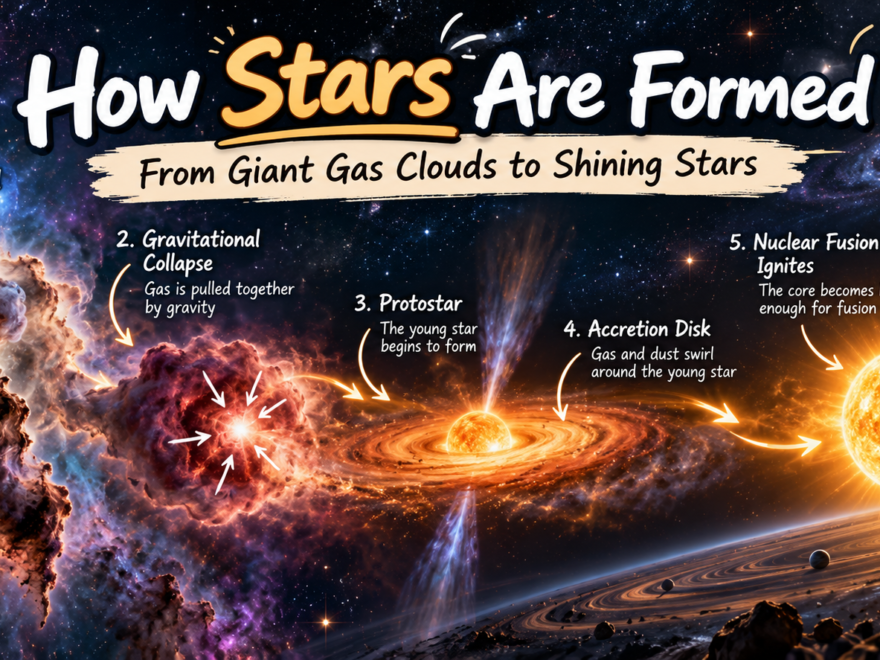
1. Gravity Causes a Gas Cloud to Collapse
The first major stage in how stars are formed is gravitational collapse.
Within a molecular cloud, some regions become denser than their surroundings. If gravity becomes strong enough, the gas begins falling inward.
This collapse can be influenced by internal cloud dynamics and, in some circumstances, external disturbances such as expanding shells of gas or nearby stellar activity.
As the cloud contracts, gravitational potential energy is converted into heat and motion.
The collapsing region may also fragment into smaller concentrations of material, potentially producing multiple stars rather than a single object.
This helps explain why stars frequently form in groups or clusters.
2. A Protostar Begins to Develop
As gas continues moving toward the center of a collapsing region, a dense central object begins to form.
This early developing object is called a protostar.
A protostar is not yet a fully developed main-sequence star because sustained hydrogen fusion has not begun in its core.
Instead, much of its energy comes from gravitational contraction and the accumulation of surrounding material.
The developing protostar is often hidden inside dust, making it difficult to observe with visible-light telescopes.
Astronomers therefore use infrared and radio observations to study young stellar objects embedded within star-forming clouds.
3. A Rotating Disk Forms Around the Young Star
Interstellar clouds usually contain some angular momentum. As a cloud contracts, its rotation can become more significant.
Rather than falling directly into the center, some material settles into a rotating disk around the protostar.
This structure is known as an accretion disk during the early stages of stellar development.
Gas and dust within the disk can gradually move inward, contributing to the growth of the central object.
Some young stars also produce powerful jets and outflows that carry material and angular momentum away from the forming system.
These processes help regulate how matter accumulates and influence the surrounding environment.
4. The Core Becomes Hotter and Denser
As more material accumulates, gravity compresses the developing star.
The central temperature and pressure rise as the object continues contracting.
For a sufficiently massive protostar, conditions eventually become extreme enough for hydrogen nuclei to begin participating in fusion reactions.
However, reaching the necessary conditions depends strongly on the object’s mass.
Objects that do not accumulate enough mass to sustain ordinary hydrogen fusion become brown dwarfs rather than main-sequence stars.
This distinction demonstrates why gravity and mass are central to understanding stellar development.
5. Nuclear Fusion Turns a Protostar Into a Star
One of the most important events in stellar formation occurs when sustained hydrogen fusion becomes established in the core.
During this process, hydrogen nuclei ultimately combine to form helium, releasing energy because a small amount of mass is converted into energy.
The relationship between mass and energy is described by Einstein’s equation:
The released energy travels outward through the star and eventually escapes as radiation.
Once a star settles into a stable period of core hydrogen fusion, it enters the main-sequence stage of its life.
This is the stage currently occupied by our Sun.
What Keeps a Star From Collapsing?
A stable main-sequence star maintains a balance between gravity and internal pressure.
Gravity pulls matter inward, while pressure generated by the hot stellar interior supports the star against further collapse.
This condition is known as hydrostatic equilibrium.
Energy produced through nuclear fusion helps maintain the high temperatures required for this pressure support.
Although stars gradually evolve as their internal composition changes, hydrostatic equilibrium allows them to remain relatively stable for long periods.
How Long Does It Take for a Star to Form?
The time required for star formation depends on factors such as mass, density, temperature, and the surrounding environment.
Some massive stars develop relatively quickly, while lower-mass stars can take much longer to complete their early evolution.
The process from molecular cloud collapse to a stable main-sequence star may take millions to tens of millions of years, with substantial variation between different stellar masses.
The exact duration also depends on which stage astronomers use to define the beginning and end of star formation.
Why Do Stars Have Different Sizes and Colors?
Not all stars form with the same mass.
The amount of material accumulated during formation strongly influences a star’s temperature, luminosity, color, and lifespan.
| Star Characteristic | General Explanation |
|---|---|
| Blue appearance | Usually associated with hotter stellar surfaces |
| Red appearance | Usually associated with cooler stellar surfaces |
| High mass | Generally produces greater luminosity and shorter main-sequence lifetimes |
| Low mass | Generally produces lower luminosity and longer main-sequence lifetimes |
| Sun-like mass | Can support stable hydrogen fusion for billions of years |
A star’s color is primarily related to its surface temperature, although observations can also be affected by dust and other factors.
Massive stars consume their nuclear fuel much more rapidly than low-mass stars, despite beginning with larger fuel supplies.
Can Planets Form at the Same Time as Stars?
Planet formation is closely connected to the early development of stellar systems.
The disk of gas and dust surrounding a young star provides material from which planets and smaller bodies may develop.
Dust grains can collide and stick together, gradually forming larger solid structures under suitable conditions.
Over time, some of these structures may grow into planetesimals and planetary embryos.
However, planet formation is complex, and not every young star necessarily develops the same planetary architecture.
Observations of protoplanetary disks help astronomers investigate how planetary systems emerge.
How Do Astronomers Observe Stars Being Born?
Because star formation often occurs behind thick clouds of dust, astronomers rely on instruments capable of detecting wavelengths beyond visible light.
Infrared telescopes can reveal young stellar objects that would otherwise remain hidden.
Radio and millimeter-wave observatories can trace cold molecular gas and dust in star-forming regions.
Space telescopes and ground-based observatories also help scientists study jets, disks, and the structure of stellar nurseries.
One well-known example is the Orion Nebula, a nearby region containing young stars and active star formation.
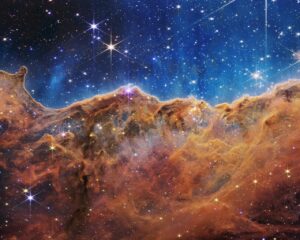
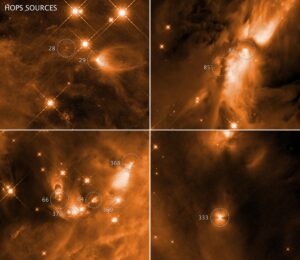
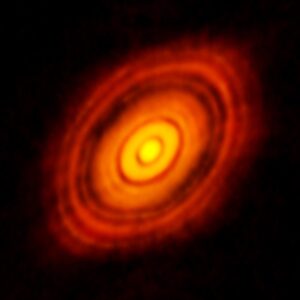
These observations provide evidence for different stages of stellar development and help scientists test models of how stars form.
Why Star Formation Matters to the Universe
Stars are fundamental to the evolution of galaxies.
As generations of stars form, evolve, and die, they influence the surrounding interstellar medium through radiation, stellar winds, and other processes.
Stars also play a central role in the production and distribution of chemical elements.
Many elements heavier than helium are produced through stellar nuclear reactions or other astrophysical processes associated with stellar evolution and stellar remnants.
These materials can later become part of new stars, planets, and other astronomical objects.
Studying star formation therefore helps explain not only where stars come from, but also how the universe develops increasingly complex structures.
Conclusion
Understanding how stars are formed begins with cold molecular clouds and the gravitational collapse of dense regions. As material accumulates, a protostar develops, surrounded by gas and dust that may eventually contribute to the formation of planets.
When the central temperature and pressure become sufficient for sustained hydrogen fusion, the developing object enters the main-sequence stage and becomes a stable star.
From stellar nurseries to planetary systems, star formation is an essential process that shapes galaxies and provides the foundations for much of the matter and energy we observe throughout the universe.