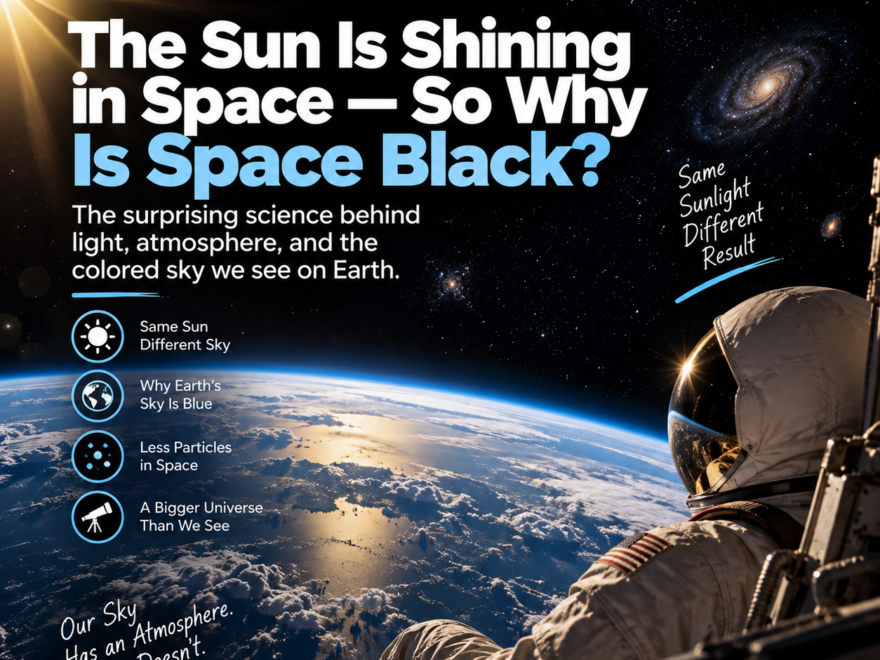
Look up during the day.
The sky is bright blue.
The Sun is so bright that staring directly at it is dangerous.
Sunlight reaches Earth from roughly 150 million kilometers away.
Now look at a photograph taken in space.
The Sun is still there.
Astronauts are surrounded by sunlight.
Spacecraft can be brightly illuminated.
Earth can look incredibly bright.
And behind everything?
Black.
Almost completely black.
That seems strange.
If sunlight is traveling through space all the time, shouldn’t space itself be glowing?
Learning why is space black reveals something fascinating about light:
we normally do not see light simply because it exists.
We see light when it reaches our eyes from a source or after interacting with something.
And space contains far less material for sunlight to interact with than Earth’s atmosphere does.
First, Think About an Empty Room
Imagine a completely dark room.
Now shine a flashlight across it.
If the air is relatively clean, you mostly see:
the flashlight itself,
and whatever surface the beam hits.
You do not necessarily see a bright solid line floating between the flashlight and the wall.
Why?
Because most of the light is traveling forward.
It needs to scatter toward your eyes for you to see the beam from the side.
Add smoke or dust?
Suddenly the beam becomes visible.
The particles scatter some of the light toward you.
Earth’s atmosphere does something similar on a much larger scale.
Earth’s Sky Is Full of Molecules
Standing outside may feel like standing in empty space.
It isn’t.
You are living at the bottom of an atmosphere containing enormous numbers of:
nitrogen molecules,
oxygen molecules,
water vapor,
tiny particles,
and other gases.
Sunlight enters this atmosphere and interacts with it.
Some of that light gets scattered in different directions.
Eventually, some scattered light reaches your eyes.
That is why you can look away from the Sun and still see a bright sky.
Why Is the Sky Blue?
Sunlight looks white, but it contains many wavelengths of visible light.
Different wavelengths interact with the atmosphere differently.
Shorter visible wavelengths are scattered more strongly by molecules in Earth’s atmosphere than longer wavelengths.
Blue light is therefore scattered extensively across the sky.
Your eyes receive that scattered blue light from many directions.
Result:
blue sky.
The Blue Is Not a Giant Ceiling
There is no blue surface above Earth.
No enormous blue dome.
The color comes from sunlight interacting with the atmosphere between you and space.
Climb higher through the atmosphere and there is progressively less material above you to scatter sunlight.
Eventually, the sky becomes much darker.
Space Does Not Have an Atmosphere Like Earth’s
Interplanetary space is not perfectly empty.
It contains:
particles,
gas,
dust,
radiation,
magnetic fields,
and plenty of other interesting things.
But compared with Earth’s atmosphere, it is extraordinarily sparse.
There simply are not enough nearby molecules to scatter sunlight across your entire field of view the way Earth’s atmosphere does.
So when you look into a direction without a bright object?
You mostly see darkness.
But Sunlight Is Still Passing Through Space
Absolutely.
This is the part that initially feels confusing.
Sunlight can be traveling directly through the region you are looking at.
But unless that light is redirected toward your eyes, you do not necessarily see it.
Think about the flashlight again.
Light can cross the room without making the entire room appear like a glowing wall.
Space works similarly, except it is far emptier.
Objects in Space Can Be Extremely Bright
Put a spacecraft in direct sunlight.
One side can be brilliantly illuminated.
Why?
Because sunlight strikes the spacecraft.
The material reflects some of that light.
Some reflected light reaches a camera or astronaut’s eyes.
Now the spacecraft is visible.
The darkness behind it does not mean sunlight disappeared.
It means there is very little nearby material in that direction scattering sunlight back toward the observer.
The Moon Gives Us a Great Example
The Moon is exposed to intense sunlight.
Its daytime surface can be extremely bright.
Yet photographs taken on the lunar surface show a black sky.
Why?
The Moon does not have a substantial atmosphere like Earth’s to scatter sunlight across the sky.
So you can have:
bright ground,
bright astronaut,
bright spacecraft,
and black sky
all in the same scene.
That combination feels unusual because we never experience it naturally on Earth’s surface.
Daytime on the Moon Still Has a Black Sky
This is worth emphasizing.
On Earth:
daytime = bright sky.
On the Moon:
daytime can mean sunlight illuminating the surface while the sky remains black.
“Day” does not automatically create a bright sky.
A bright sky requires something that interacts with the incoming light.
Earth has an atmosphere.
The Moon essentially does not.
So Why Can We See Stars?
Stars are light sources.
Their light travels across enormous distances and enters our eyes or telescopes.
We see the star because its light reaches us directly.
But between stars, there may be no sufficiently bright source along our line of sight.
So those regions appear dark.
At least to human eyes.
Space Is Not Actually Empty or Completely Dark
This is where things become even more interesting.
When astronomers use sensitive instruments, the universe contains many forms of background radiation and faint light.
There is:
starlight,
light from galaxies,
interstellar dust emission,
zodiacal light,
cosmic background radiation,
and more.
So “space is black” is largely about what our eyes perceive.
The universe is not literally an absolute absence of electromagnetic radiation.
Your Eyes Only Detect a Tiny Part of Reality
Human vision detects a narrow region of the electromagnetic spectrum.
We call it visible light.
But the universe also contains:
radio waves,
microwaves,
infrared,
ultraviolet,
X-rays,
gamma rays.
If your eyes could naturally detect all of these wavelengths, the sky would look profoundly different.
Thankfully, your brain does not need to process an X-ray panorama every time you look outside.
Telescopes Can See a Universe We Cannot
Astronomers build instruments specifically designed to detect wavelengths outside human vision.
An object that looks dark or invisible to your eyes may appear incredibly bright in:
infrared,
radio,
X-ray,
or another wavelength.
This is why astronomy images taken at different wavelengths can reveal completely different structures.
The universe did not change.
We changed the detector.
But There Is a Bigger Question
Okay.
The space between nearby objects looks dark because there is not enough scattered sunlight.
Fair enough.
But the universe contains an enormous number of stars.
Potentially stars in nearly every direction.
So why doesn’t the combined light of all those stars make the entire night sky bright?
Excellent question.
Astronomers have thought about this for centuries.
This Leads to Olbers’ Paradox
Imagine an infinite universe that is:
eternal,
static,
and filled roughly uniformly with stars.
Look in any direction.
Eventually your line of sight should end on a star.
If that model were correct, the entire night sky should theoretically be bright.
But it isn’t.
This puzzle became known as Olbers’ paradox, named after astronomer Heinrich Wilhelm Olbers, although versions of the problem were discussed by others before him.
The darkness of the night sky tells us something important about the universe.
The Universe Has a Finite Age
Our observable universe has not existed forever.
The universe is about 13.8 billion years old according to current cosmological measurements.
Light travels at a finite speed.
That means light from sufficiently distant regions has not had unlimited time to reach us.
We can only observe regions whose light has had enough time to arrive.
So we are not receiving light from an infinitely old collection of stars.
Looking Far Away Means Looking Back in Time
This is one of the strangest facts in astronomy.
Light takes time to travel.
The Moon?
We see it roughly 1.3 seconds in the past.
The Sun?
About eight minutes in the past.
Nearby stars?
Years in the past.
Distant galaxies?
Millions or billions of years in the past.
Astronomy is therefore a kind of time machine.
Every telescope is looking backward.
The Universe Is Also Expanding
There is another important piece.
The universe is expanding.
Light traveling across expanding space can have its wavelength stretched.
This phenomenon is known as cosmological redshift.
Light that originally had shorter wavelengths may arrive at longer wavelengths.
For sufficiently distant sources, radiation can shift outside the visible range our eyes detect.
So not all ancient cosmic light reaches us as visible light.
Some Ancient Light Is Still Everywhere
Here comes the fun part.
The early universe was once extremely hot and dense.
As the universe expanded and cooled, radiation from that early period continued traveling through space.
We can still detect it today.
It is called the cosmic microwave background.
It exists in every direction.
So in a sense, the sky is filled with ancient light.
Your eyes simply cannot see it because its wavelength is now primarily in the microwave part of the spectrum.
Imagine Having Microwave Vision
If humans could naturally perceive microwave radiation the way we see visible light, our perception of the sky would be completely different.
There would be a background signal almost everywhere.
What appears to our eyes as blackness is partly a limitation of biology.
Darkness does not necessarily mean nothing is there.
Sometimes it means:
your detector is looking at the wrong wavelength.
Why Doesn’t Sunlight Illuminate Empty Space Like a Lamp Illuminates a Room?
Because your room is not empty.
Light from a lamp:
hits walls,
reflects off furniture,
scatters from surfaces,
and bounces around.
That reflected light reaches your eyes from many directions.
Now remove:
the walls,
floor,
ceiling,
furniture,
dust,
and almost all the air.
Put the lamp in an enormous vacuum.
The lamp itself would still be visible.
Anything it illuminated would still be visible.
But the surrounding emptiness would remain dark.
Congratulations.
You have created a terrible living room but a useful space analogy.
Dust Can Make Light Visible in Space
Space does contain dust.
And when light interacts with enough material, we can sometimes see beautiful illuminated structures.
Nebulae are an excellent example.
Some clouds of gas and dust can:
emit light,
reflect nearby starlight,
or block light behind them.
Suddenly the darkness becomes filled with structure.
Reflection Nebulae Are Cosmic Evidence
Some nebulae become visible partly because dust reflects and scatters light from nearby stars.
This is basically the cosmic version of seeing light because it interacted with something.
Without the dust?
The starlight would still travel.
But we might not see a glowing cloud in that location.
Why Do Astronaut Photos Sometimes Show No Stars?
This causes endless internet confusion.
Someone sees a photograph of an astronaut on the Moon.
Black sky.
No stars.
Then asks:
“Where are all the stars?”
Usually, the answer involves camera exposure.
The lunar surface and astronauts in direct sunlight are very bright.
Camera settings are adjusted to expose those bright subjects correctly.
Faint stars then become too dim to register in the same exposure.
Try Photographing Stars Beside a Streetlight
You can reproduce the basic problem on Earth.
Take a photo at night with a bright lamp dominating the frame.
Expose for the lamp.
What happens to faint stars?
Many disappear.
Now use a longer exposure optimized for the night sky.
Stars appear.
But the bright foreground may become overexposed.
Cameras have limited dynamic range.
Space photography still follows photography rules.
Human Eyes Adapt Too
Walk outside from a brightly lit room.
Look at the stars.
At first?
Not many.
Wait twenty minutes.
More stars appear.
Your eyes adapt to darkness.
Astronauts looking at a brightly illuminated surface may not simultaneously perceive faint stars as easily as someone whose vision has fully adapted to darkness.
Space Is Extremely High Contrast
On Earth, atmospheric scattering creates a lot of ambient light.
Shadows are often softened by:
sky light,
reflections,
and surrounding surfaces.
In space or on the Moon, direct sunlight can create much more dramatic contrast.
Bright areas can be extremely bright.
Shadows can be extremely dark.
There is less atmospheric scattering to fill them in.
Shadows in Space Can Look Almost Unreal
Imagine standing on the Moon.
Sunlight hits one side of a rock.
The other side receives no direct sunlight.
On Earth, the atmosphere and surrounding environment scatter light into shadows.
On the Moon, that effect is much weaker.
The transition can look dramatic.
It almost resembles studio lighting.
Except the studio is approximately 384,000 kilometers away.
Does Space Have a Color?
Interesting question.
If by “space” you mean vacuum itself, there is no simple paint color assigned to it.
What you see depends on:
light sources,
material,
wavelength,
your detector,
and viewing conditions.
To human eyes, empty regions without visible light arriving from them appear black.
But astronomy constantly reminds us that black does not mean empty.
Black Is What Your Visual System Reports
Your eyes detect photons.
If very few visible photons arrive from a particular direction, your visual system interprets that region as dark.
It is similar to silence.
Silence does not necessarily mean the universe contains no vibrations anywhere.
It means your ears are not receiving enough sound within the frequencies and intensity they can detect.
Black space is partly a sensory statement.
Could You Shine a Flashlight Into Space?
Yes.
The photons would travel outward.
Would you see a giant glowing beam extending forever?
No.
Not unless enough material scattered some of that light back toward you.
Point a flashlight into a vacuum and the beam itself can be surprisingly difficult to see from the side.
Again:
light needs to reach your eyes.
Lasers Demonstrate This Nicely
Laser beams often appear as bright lines in movies.
In clean air, the beam itself may be difficult to see from the side.
Add:
fog,
smoke,
dust,
or mist,
and suddenly the path becomes obvious.
Those particles scatter light toward the observer.
The same basic principle helps explain why Earth’s atmosphere creates a visible sky while empty space remains dark.
Earth’s Atmosphere Is Doing Visual Work All Day
We barely notice it because we have never lived without it.
The atmosphere gives us:
blue daytime skies,
red and orange sunsets,
atmospheric haze,
softened shadows,
and many other optical effects.
Remove the atmosphere and our visual experience changes dramatically.
The sky becoming black is just one consequence.
Sunsets Are Part of the Same Story
When the Sun is near the horizon, sunlight travels through more atmosphere before reaching your eyes.
Shorter wavelengths are scattered strongly along the longer path.
More of the longer red and orange wavelengths can dominate the direct sunlight reaching you.
Result:
sunset.
Blue sky and red sunset are therefore related atmospheric phenomena.
Both involve light interacting with Earth’s atmosphere.
Mars Has Its Own Version
Mars has an atmosphere too.
But it is very different from Earth’s and contains abundant dust.
The Martian sky can therefore display colors and scattering behavior very different from what we experience here.
This is another reminder:
the color of a planet’s sky depends on what its atmosphere contains.
An Alien Sky Might Be Completely Different
Imagine a planet orbiting another star.
Different atmospheric chemistry.
Different particle sizes.
Different star spectrum.
Its daytime sky might not resemble Earth’s familiar blue at all.
A sky’s color is not universal.
It is a product of physics and environment.
Blue Skies Are Actually Something Special
We experience them every day and barely notice.
But think about what is happening.
Photons leave the Sun.
Travel about 150 million kilometers.
Enter Earth’s atmosphere.
Interact with molecules.
Scatter.
Some happen to travel toward your eyes.
Your brain processes their wavelengths.
And you experience:
blue.
A normal Tuesday afternoon is already a physics experiment.
Darkness Can Contain Enormous Things
Look at a dark patch of night sky.
It appears empty.
But within that tiny region may exist:
distant stars,
galaxies,
gas,
dust,
planets,
black holes,
and radiation traveling across cosmic distances.
Your eyes simply cannot resolve most of it.
Darkness is not evidence of emptiness.
The Hubble Deep Field Proved This Beautifully
Astronomers once pointed the Hubble Space Telescope toward a region of sky that looked remarkably empty.
With a long exposure, that tiny dark patch revealed thousands of distant galaxies.
What looked like almost nothing contained an enormous amount of cosmic structure.
This is one of astronomy’s recurring lessons:
look longer, and emptiness often disappears.
Modern Telescopes Push This Even Further
Powerful observatories can detect extremely faint and distant galaxies.
The deeper we observe, the more cosmic history becomes visible.
Some objects are so distant that their light began traveling toward us billions of years ago.
When we detect them, we are seeing the universe at a much younger age.
The black background becomes an archive.
So Is Space Really Black?
To ordinary human vision?
Mostly, yes.
But scientifically?
The answer needs context.
Space contains radiation across the electromagnetic spectrum.
There are stars and galaxies in countless directions.
There are faint backgrounds and glowing structures.
There is dust and gas.
There is ancient microwave radiation.
The black appearance is largely the result of:
low visible-light intensity in many directions,
limited scattering,
cosmic expansion,
the finite age of the observable universe,
and the limitations of human vision.
That is much more interesting than simply saying:
“Space is dark.”
Try This Tonight
Go outside after sunset.
Find somewhere relatively dark.
Look between the stars.
Choose one apparently empty patch.
Then remember:
that black region may contain galaxies so distant and faint that your eyes have absolutely no chance of detecting them.
The darkness is not necessarily nothing.
It is information you cannot access with your current equipment.
Your eyes are excellent.
The universe is just ridiculously large.
FAQ
Why is space black even though the Sun is shining?
Space contains very little material compared with Earth’s atmosphere, so sunlight is not scattered toward our eyes from every direction. Objects illuminated by the Sun can be bright while the surrounding space still appears black.
Why is Earth’s sky blue instead of black?
Molecules in Earth’s atmosphere scatter sunlight. Shorter visible wavelengths are scattered more strongly, producing the blue appearance of the daytime sky.
Why is the Moon’s sky black during the day?
The Moon lacks a substantial atmosphere capable of scattering sunlight across the sky. Its surface can therefore be brightly illuminated while the sky remains black.
Why aren’t stars visible in many astronaut photographs?
Camera exposure is often adjusted for brightly illuminated astronauts, spacecraft, or lunar surfaces. Stars are much fainter and may not register under those exposure settings.
Is space completely dark?
No. Space contains visible light and radiation across many other wavelengths, including infrared, radio, X-rays, and microwaves. Human eyes detect only a small portion of the electromagnetic spectrum.
Why isn’t the entire night sky filled with stars?
The universe has a finite age, light travels at a finite speed, and cosmic expansion stretches light from distant objects. These factors help resolve the classic question known as Olbers’ paradox.
Conclusion
The Sun is shining.
Its light is crossing space in enormous quantities.
Yet the space around it looks black.
That seems contradictory until you remember one simple rule:
Light has to reach your eyes.
Earth’s atmosphere scatters sunlight toward us from all directions.
That creates our bright daytime sky.
Remove most of that atmosphere and suddenly the background becomes dark—even while nearby objects remain brilliantly illuminated.
But perhaps the strangest part is this:
the darkness is not truly empty.
Behind those black regions are:
stars,
galaxies,
dust,
radiation,
and billions of years of cosmic history.
Some of it is too faint.
Some too distant.
Some exists at wavelengths your eyes cannot detect.
So when you look into space and see nothing but black, you are not necessarily looking at nothing.
You may simply be looking at more universe than your eyes know how to see.