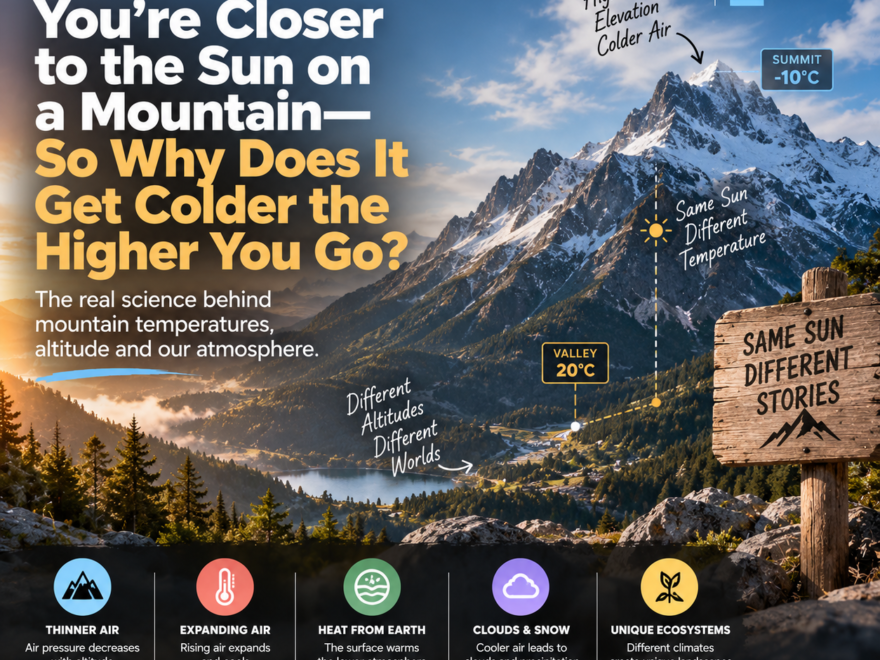
Stand at the bottom of a mountain on a warm summer day and you might be comfortable in a T-shirt.
Drive upward for a few hours.
Suddenly you need a jacket.
Keep climbing high enough and you might even find snow.
At first, that seems backwards.
You are going up.
Technically, you are getting closer to the Sun.
So shouldn’t the top of the mountain be warmer?
After all, if a heater is warming a room, moving closer to it usually makes you warmer.
But Earth’s atmosphere does not work like a room with a giant heater hanging above it.
Understanding why it is colder at higher elevations requires looking at where the atmosphere gets much of its heat, what happens to air pressure as altitude increases, and what happens when rising air expands.
And once you understand that, a lot of other mountain phenomena suddenly start making sense too.
First, Yes—The Mountain Really Is Closer to the Sun
Let’s get the obvious part out of the way.
If you climb a mountain, you are technically closer to the Sun.
But the difference is tiny compared with the total distance between Earth and the Sun.
A mountain several kilometers high barely changes that distance.
Imagine Standing One Meter Closer to a Lamp That Is Millions of Kilometers Away
The difference would be practically meaningless.
The same basic idea applies here.
Mountain Height Is Tiny on an Astronomical Scale
Mount Everest rises about 8.8 kilometers above sea level.
The average distance between Earth and the Sun is roughly 150 million kilometers.
Those numbers are not remotely comparable.
So getting a few kilometers closer to the Sun does not explain mountain temperature.
The Sun Doesn’t Mainly Heat the Air From Above
This is the part that changes everything.
Sunlight travels through Earth’s atmosphere and reaches the surface.
Land and water absorb solar energy.
The surface warms.
Then the warmed surface transfers energy to the atmosphere above it through several processes.
In Other Words, Much of the Lower Atmosphere Is Heated From Below
That means being farther from Earth’s surface can matter more than being a few kilometers closer to the Sun.
Think About a Sunny Parking Lot
The pavement can become extremely hot.
Air immediately above it is influenced by that heated surface.
Move farther away from the ground and the relationship changes.
Mountains take you upward through the atmosphere, away from the low-elevation surface conditions.
But that is only part of the explanation.
Air Pressure Decreases With Altitude
At sea level, you have a huge column of atmosphere above you.
All that air contributes to atmospheric pressure.
Climb higher and there is less atmosphere above your position.
So Air Pressure Drops
This is why high-altitude environments feel different in more ways than temperature alone.
There is also less oxygen available per breath because the air pressure is lower.
Pressure Is Crucial to Understanding Temperature
Because when air rises into lower pressure, something important happens.
It expands.
Rising Air Expands
Imagine a parcel of air near the surface beginning to rise.
As it moves upward, the surrounding atmospheric pressure becomes lower.
The air parcel can expand.
Expansion Requires Energy
As the parcel expands, its internal energy changes.
Its temperature drops.
This is called adiabatic cooling when the temperature change occurs because of expansion without heat being added from or removed to the surrounding environment in the idealized process.
This Is One of the Main Reasons Rising Air Cools
And it helps explain why temperature generally decreases with altitude through the troposphere.
The Reverse Happens When Air Sinks
Now take air higher in the atmosphere and move it downward.
As it descends, atmospheric pressure increases.
The air becomes compressed.
Compression Warms the Air
So:
rising air → expands → cools.
sinking air → compresses → warms.
This simple relationship is incredibly important in weather and climate.
It influences:
clouds,
rainfall,
mountain weather,
dry regions,
and many other atmospheric processes.
What Is the Temperature Lapse Rate?
Meteorologists use the concept of a lapse rate to describe how atmospheric temperature changes with height.
In the lower atmosphere, temperature generally decreases as elevation increases.
But There Isn’t One Fixed Number Everywhere, Every Day
The actual temperature profile depends on atmospheric conditions.
Moisture matters.
Weather matters.
Time of day matters.
Air movement matters.
The landscape matters.
A Common Rule of Thumb Is Useful
You may hear that temperature decreases by roughly several degrees Celsius for every 1,000 meters of elevation gain.
That’s useful for rough expectations.
But it should not be treated as an unbreakable law.
Dry Air and Moist Air Cool Differently
Here the story becomes more interesting.
Unsaturated rising air cools at what is called the dry adiabatic lapse rate.
Once air becomes saturated and condensation begins, the temperature changes differently.
Why?
Because condensation releases latent heat.
Water vapor changing into liquid water releases energy into the surrounding air.
That partially offsets the cooling associated with expansion.
This Is Why Moist Atmospheric Processes Matter So Much
Water is not merely something that falls from clouds.
It plays an enormous role in atmospheric energy.
This Helps Explain Why Mountains Create Clouds
Imagine moist air approaching a mountain range.
The terrain forces the air upward.
As the air rises:
pressure decreases,
the air expands,
and the air cools.
Cooler Air Can Reach Saturation
Water vapor begins condensing.
Clouds form.
If conditions allow, precipitation follows.
This Is Called Orographic Lift
Mountains physically force air to rise.
That can dramatically change local weather.
Why One Side of a Mountain Can Be Wet and the Other Dry
This is one of the most dramatic consequences.
Moist air approaches the mountain.
It rises.
Cools.
Forms clouds.
Produces rain or snow.
Then the air crosses the mountain and begins descending.
Descending Air Warms
As pressure increases, the air compresses.
Relative humidity decreases.
Clouds can dissipate.
The Far Side Can Become Much Drier
This contributes to a phenomenon known as a rain shadow.
A mountain range can therefore create dramatically different landscapes on opposite sides.
One side:
green.
Forested.
Wet.
The other:
dry.
Sparse.
Sometimes even desert-like.
Same Mountain
Completely different climate influence.
So Why Is There Snow on Mountains in Warm Places?
Now the classic question.
You can have warm conditions near sea level while a nearby mountain summit remains covered in snow.
Elevation Changes Temperature
If the mountain is high enough, summit temperatures may remain cold enough for snow to accumulate or persist much longer than at lower elevations.
Latitude Still Matters
A mountain near the equator needs to be very high to reach consistently cold conditions.
A mountain at high latitude may encounter cold conditions at much lower elevation.
Snowline Is Not Fixed Globally
It depends on:
latitude,
temperature,
precipitation,
season,
slope orientation,
and regional climate.
Why Can Mountains Near the Equator Have Snow?
Because latitude and altitude affect climate differently.
Near the equator, incoming solar energy is generally strong.
But climb high enough and atmospheric conditions become much colder.
High Elevation Can Overcome Tropical Warmth
Historically, some very high equatorial mountains have supported glaciers.
This surprises people because we associate ice with places near the poles.
But Ice Cares About Temperature and accumulation—not postcards
If conditions remain cold enough and sufficient snow accumulates, ice can persist.
Why Does Breathing Become Harder at High Altitude?
Temperature is not the only thing changing.
Atmospheric pressure also decreases with elevation.
The Percentage of Oxygen in the Atmosphere Remains Roughly Similar
But lower pressure means fewer air molecules are present in a given volume compared with sea level conditions.
Each Breath Provides Less Oxygen to Your Body
Your body responds.
Breathing rate may increase.
Heart rate may change.
And with enough elevation, acclimatization becomes important.
This Is Why Altitude Is a Physiological Challenge
Not merely a colder version of sea level.
Does Thin Air Mean There Is Less Heat?
You will sometimes hear:
“Mountains are cold because the air is thinner.”
That is not entirely useless, but it is incomplete.
Lower Air Density and Pressure Are Part of the Environment
But the critical atmospheric process involves how air behaves as pressure changes.
Rising air expands and cools.
Avoid Reducing the Explanation to “Less Air = Colder”
Atmospheric thermodynamics is more interesting than that.
Why Can the Sun Feel Stronger on a Cold Mountain?
This creates another apparent contradiction.
You are freezing.
But sunlight on your skin feels intense.
How?
High-Elevation Sun Exposure Can Be Strong
At higher altitude, sunlight travels through less atmosphere before reaching you.
Ultraviolet exposure can therefore be greater than at lower elevation under otherwise comparable conditions.
Snow Can Make This More Significant
Snow reflects substantial ultraviolet radiation.
So exposure can come from above and reflected surfaces.
Cold Does Not Mean Weak Sun
This is why sun protection matters in mountain environments even when the air temperature is low.
You Can Get Sunburned While Surrounded by Snow
Your brain associates sunburn with:
beaches,
summer,
heat.
But ultraviolet radiation is not the same thing as air temperature.
A Freezing Mountain Can Still Deliver Significant UV Exposure
Temperature tells you how hot or cold the air is.
It does not directly tell you how much ultraviolet radiation reaches your skin.
Different measurements.
Different processes.
Why Does the Temperature Sometimes Get Warmer as You Climb?
Wait.
Didn’t we just establish that higher means colder?
Usually in the troposphere, yes.
But not always at every location and every moment.
Temperature Inversions Can Reverse the Pattern
Under certain atmospheric conditions, colder air can become trapped near the ground while warmer air sits above it.
Valleys Are Especially Interesting
Cold, dense air can drain downhill and collect in low areas.
This can make a valley floor colder than slopes above it.
Suddenly the Mountain Rule Appears Broken
But it isn’t.
You are observing a specific atmospheric structure rather than the average environmental lapse pattern.
Temperature Inversions Can Be Dramatic
Imagine waking in a valley covered in fog.
Drive uphill.
Eventually you emerge above the fog.
Sunshine.
Blue sky.
And surprisingly warmer air.
The Valley Is Sitting Inside a Pool of Cold Air
This can happen particularly during stable weather conditions.
Mountains Create Microclimates
Elevation is important.
But terrain complicates everything.
Why Are Valleys Often Cold at Night?
After sunset, the ground loses heat.
Air near the surface cools.
Cooler air is denser.
Gravity Encourages Cold Air to Move Downslope
It can collect in valleys and depressions.
This process is sometimes called cold-air drainage.
Farmers Have Known This for Generations
Low-lying areas can be more vulnerable to frost.
A field slightly higher on a slope may remain warmer during certain nights.
Geography Changes Temperature Over Surprisingly Short Distances
Sometimes a few hundred meters horizontally can matter.
Which Side of a Mountain Is Warmer?
That depends heavily on location and hemisphere.
Slope orientation changes the amount of solar radiation received.
In the Northern Hemisphere
South-facing slopes often receive more direct sunlight than north-facing slopes.
They can therefore be warmer and drier.
In the Southern Hemisphere
The general relationship reverses.
North-facing slopes may receive more direct sunlight.
This Can Change Vegetation
One side of a valley might be:
dry grassland.
The opposite side:
dense forest.
And the difference may largely reflect sunlight exposure.
Mountains Create Climate in Layers
Walk from a valley to a high summit and you may pass through multiple ecological zones.
At the bottom:
grassland.
Higher:
forest.
Higher still:
subalpine vegetation.
Then:
alpine tundra.
Eventually:
rock,
snow,
or ice.
You Traveled Vertically Through Climate Zones
It is almost like traveling toward the poles without moving thousands of kilometers north or south.
Elevation Compresses Climate Into a Mountain
That is one reason mountains support such diverse ecosystems.
Why Don’t Trees Grow Above a Certain Elevation?
Eventually conditions become too difficult for normal tree growth.
This boundary is called the treeline.
Temperature Is a Major Factor
But so are:
wind,
snow,
soil,
growing-season length,
and exposure.
Treeline Elevation Varies Around the World
It is not the same number on every mountain.
Latitude and local climate strongly influence it.
Why Are High Mountains So Windy?
Mountains interact with atmospheric flow.
Terrain can accelerate, redirect, lift, and disturb moving air.
Higher Elevations Are Also More Exposed
There may be fewer obstacles such as:
trees,
buildings,
or surrounding terrain
to reduce wind.
Wind Changes How Cold It Feels
The actual air temperature may be one value.
Your body may experience heat loss more rapidly because of wind.
This produces the familiar idea of wind chill.
Wind Chill Does Not Make Objects Colder Than the Air
This is an important distinction.
Wind can make exposed human skin lose heat faster.
But it does not magically cool an inanimate object below the surrounding air temperature simply because wind is blowing.
“Feels Like” Temperature Is About Heat Transfer
Not a new actual air temperature.
Why Does Weather Change So Fast in the Mountains?
Mountain weather has a reputation for unpredictability.
Part of the reason is terrain.
Mountains Force Air to Move Vertically
They influence:
cloud formation,
wind,
precipitation,
and local circulation.
Conditions Can Differ Across Short Distances
Sunny valley.
Cloudy ridge.
Snowing summit.
All at the same time.
Elevation Magnifies Differences
A relatively small geographic area can contain several atmospheric environments.
This Is Why Mountain Forecasts Need Elevation
“Temperature: 20°C.”
Where?
The town?
The trailhead?
The summit?
A Forecast Without Elevation Context Can Be Misleading
Mountain travelers need to consider conditions at the altitude they actually plan to reach.
The Valley Forecast Is Not the Summit Forecast
That sounds obvious.
It is still ignored surprisingly often.
Why Can a Mountain Be Warm During the Day and Freezing at Night?
Thin, dry high-altitude environments can experience large temperature swings.
Solar Heating Can Be Strong During Daylight
Then after sunset, surfaces lose energy.
Under clear and dry conditions, nighttime cooling can be significant.
Daily Temperature Range Depends on Many Variables
Clouds.
Humidity.
Wind.
Terrain.
Season.
Elevation.
Mountain Clothing Needs to Handle Change
Not merely one predicted temperature.
Does Every 1,000 Meters Mean the Same Temperature Drop?
No.
This is worth emphasizing because simplified charts often create the wrong impression.
The Atmosphere Is Dynamic
Temperature changes with elevation differently depending on whether air is:
dry,
moist,
rising,
sinking,
stable,
or mixed.
Meteorologists Distinguish Different Lapse Rates
The environmental lapse rate describes the actual observed temperature profile of the atmosphere.
Dry and moist adiabatic lapse rates describe how rising or sinking air parcels change temperature under particular conditions.
You Do Not Need the Equations to Understand the Main Idea
Higher elevation generally means lower pressure.
Rising air expands.
Expansion cools the air.
That is the key.
Why Does a Compressed Air Can Get Cold?
Here is an everyday comparison.
Use compressed gas from a can and the container can become cold.
The exact physics of the system differs in detail, but it provides an intuitive reminder that pressure, expansion, and temperature are connected.
Gases Behave Differently as Pressure Changes
That relationship is central to atmospheric science.
Why Isn’t Space Extremely Hot Because It Is Closer to the Sun?
This is another useful reminder that “closer to the Sun = hotter” is too simplistic.
Temperature depends on how energy is absorbed, transferred, and emitted.
Space Is Not an Extension of Earth’s Warm Air
There is no thick atmosphere transferring heat around you the way there is near Earth’s surface.
Distance Is Only One Part of Energy Balance
And within the tiny vertical range of Earth’s mountains, the distance change from the Sun is essentially irrelevant.
Elevation Can Affect Cooking Too
Go high enough and even your kitchen behaves differently.
Lower atmospheric pressure reduces the boiling point of water.
Water Boils at a Lower Temperature at High Elevation
That means boiling water may be less hot than boiling water at sea level.
Cooking Can Take Longer
Especially foods that depend on boiling temperature.
This is why recipes sometimes include high-altitude adjustments.
Baking Changes at High Altitude Too
Lower air pressure affects how gases expand in baked goods.
Water evaporates differently.
Leavening behaves differently.
Bakers in High-Elevation Cities Often Adjust Recipes
Amounts of:
liquid,
flour,
sugar,
leavening,
temperature,
or cooking time
may need modification depending on the recipe and elevation.
Altitude Is Quietly Changing Your Kitchen Physics
Not just the weather outside.
Even a Bag of Chips Notices Altitude
Take a sealed flexible package from low elevation to high elevation.
It may puff up.
Why?
The air trapped inside was packaged under different pressure conditions.
As outside atmospheric pressure decreases, the pressure difference becomes more noticeable.
The Bag Didn’t Gain More Chips
Unfortunately.
Physics simply made the packaging look more optimistic.
Your Ears Notice Pressure Changes Too
Drive rapidly up or down a mountain and your ears may pop.
Pressure Is Changing Around You
Your middle ear needs to equalize with the surrounding atmosphere.
Same Mountain
Different symptom.
Cold air.
Puffy chip bag.
Popping ears.
Breathing harder.
They all connect in some way to changing atmospheric conditions with elevation.
Mountains Are Atmospheric Laboratories
This is what makes them fascinating.
A mountain allows you to experience environmental change simply by moving upward.
In a Few Hours You Can Observe Changes in
temperature,
air pressure,
vegetation,
wind,
snow,
clouds,
and even how your body responds.
Geography Becomes Visible Physics
The landscape is demonstrating atmospheric science right in front of you.
A Simple Way to Remember Why Mountains Are Colder
Forget the idea that mountaintops should be hotter because they are closer to the Sun.
Instead remember three things.
1. Earth’s surface absorbs solar energy and helps warm the lower atmosphere.
2. Atmospheric pressure decreases as elevation increases.
3. Rising air expands as pressure decreases, causing it to cool.
Those three ideas explain much of the basic pattern.
Higher Usually Means Colder
But terrain, weather, moisture, inversions, sunlight, and local conditions can modify the details.
FAQ
Why is it colder at higher elevations?
Atmospheric pressure decreases with altitude. As air rises into lower pressure, it expands and cools. The lower atmosphere is also strongly influenced by energy absorbed and transferred from Earth’s surface.
Why are mountains colder if they are closer to the Sun?
The few kilometers of additional elevation are negligible compared with the roughly 150 million kilometers between Earth and the Sun. Atmospheric pressure and heat-transfer processes are much more important for mountain temperatures.
How much does temperature decrease with altitude?
Temperature generally decreases through the troposphere, but there is no single fixed rate that applies everywhere at all times. Moisture, weather, air movement, and atmospheric stability affect the actual lapse rate.
Why is there snow on top of mountains?
High elevations can remain cold enough for precipitation to fall and persist as snow even when lower elevations are much warmer. Latitude, precipitation, season, and local climate also influence snow cover.
Why is it harder to breathe at high altitude?
Atmospheric pressure decreases with elevation. Although oxygen still makes up roughly the same proportion of the air, the lower pressure means fewer oxygen molecules are available in each breath compared with sea-level conditions.
Can it ever be warmer higher up a mountain?
Yes. Temperature inversions can trap colder air near the ground while warmer air exists above it. This can make valleys colder than surrounding slopes under certain conditions.
Why are mountains windy?
Mountain terrain interacts with moving air, forcing it upward and around ridges and valleys. High elevations are also more exposed, which can contribute to strong winds.
Why does the Sun feel stronger at high altitude?
At higher elevation, sunlight travels through less atmosphere before reaching you, and ultraviolet exposure can be stronger. Snow can also reflect UV radiation.
Why does water boil at a lower temperature on mountains?
Lower atmospheric pressure means water requires a lower temperature to reach its boiling point. This can affect cooking at high elevations.
What is a rain shadow?
A rain shadow is a relatively dry region on the downwind side of a mountain range. Moist air rises on one side, cools and may produce precipitation; the descending air on the opposite side warms and becomes relatively drier.
Conclusion
A mountain summit is closer to the Sun.
Yet it is usually colder.
That sounds like a contradiction only if we imagine the Sun heating Earth’s atmosphere the same way a fireplace heats someone standing nearby.
It doesn’t work that way.
Understanding why it is colder at higher elevations means looking at the atmosphere itself.
Earth’s surface absorbs solar energy.
The lower atmosphere is strongly influenced by that surface.
As elevation increases, atmospheric pressure decreases.
Rising air enters that lower-pressure environment.
It expands.
And as it expands, it cools.
That basic process helps explain far more than cold mountain summits.
It helps explain:
cloud formation,
mountain rain,
snow,
rain shadows,
changing vegetation,
high-altitude weather,
and even why a sealed bag of chips looks strangely inflated after you drive into the mountains.
The mountain is not simply getting farther from warm ground.
You are moving through a changing atmosphere.
And the next time you leave a warm valley in a T-shirt only to reach the summit searching desperately for a jacket, remember:
the mountain didn’t forget that it was closer to the Sun.
The atmosphere simply plays by different rules.